If you’ve ever come back to a generator, tractor, or backup diesel tank after six months and wondered why the engine is surging, injecting black smoke, or refusing to start cleanly — you’ve already met the problem this article addresses. Diesel fuel is not indefinitely stable. Unlike a sealed container of motor oil, stored diesel is a living chemical system: it reacts with oxygen, sheds sediment, absorbs water through container condensation, and — critically — can host microbial colonies (bacteria and fungi that feed on hydrocarbons) that produce slime, acids, and black sludge capable of clogging filters and destroying injectors. “Long-term storage” in this context means anything beyond about six months without active management, and the modern fuel in your tank — called ULSD, or ultra-low sulfur diesel, the standard formulation since EPA mandated the switch in the mid-2000s — degrades faster than the older high-sulfur diesel it replaced. This guide explains why that’s true, how to identify degradation before it costs you, and which stabilizer and biocide treatments are actually worth adding to your rotation.
The on-ramp version of the bottom line: stored diesel needs two separate interventions — a stabilizer to slow oxidation and a biocide to kill microbial growth. Most products marketed as “diesel fuel treatments” do only one of those jobs. Knowing which problem you’re treating is the single most important frame shift in this guide.
Why ULSD Degrades Faster Than the Diesel You Grew Up With
The EPA’s ultra-low sulfur diesel mandate — phased in from 2006 onward and documented in the EPA’s Diesel Fuel Regulations overview — reduced sulfur content from up to 500 parts per million (ppm) down to 15 ppm. That was the right call for emissions and catalytic converter longevity. The tradeoff, documented by ASTM International in the D975 diesel fuel specification, is that sulfur compounds in older fuel acted as natural antioxidants and lubricity agents. Strip them out, and ULSD oxidizes more readily and loses lubricity faster in storage.
The oxidation process is the primary degradation pathway. Oxygen from headspace air reacts with hydrocarbon chains in the fuel, producing gums (sticky, varnish-like deposits), peroxides, and dark-colored sediment. The U.S. Energy Information Administration’s overview of ULSD standards notes that refiners now typically add lubricity improvers and antioxidants to compensate, but those additives deplete over time — and they deplete faster in warm storage, in containers with large air-to-fuel headspace ratios, and in metal containers without internal coatings that can catalyze oxidation.
By the numbers:
| Storage condition | Estimated usable life (ULSD, untreated) |
|---|---|
| Cool, dark, sealed (< 70°F), full container | 6–12 months |
| Warm garage or outbuilding (70–90°F) | 3–6 months |
| High headspace (< half-full container) | Reduce any estimate by 30–40% |
| Treated with antioxidant stabilizer | Extends 12–24 months (conditions-dependent) |
These ranges align with guidance cited in Popular Mechanics’ overview of fuel storage shelf life and are consistent with manufacturer dosage claims from leading stabilizer brands, though actual results depend heavily on baseline fuel quality at time of fill and storage temperature.
The Microbial Problem: What “Diesel Bug” Actually Is
Oxidation is slow and predictable. Microbial contamination is faster, less visible until it’s serious, and capable of ruining a full tank of fuel in weeks under the right conditions. Practical Sailor’s deep-dive on what the marine community calls “diesel bug” is the most thorough practitioner-level treatment of this problem in published form, and the core finding applies equally to land-based storage: where you have diesel, water, and warmth, you have a viable ecosystem for hydrocarbon-consuming microorganisms.
The mechanism: diesel and water don’t mix, so any water that enters a tank — through condensation, rain intrusion, or contaminated fill stock — settles to the bottom as a distinct layer. The interface between that water layer and the diesel above it is precisely where microbial colonies establish. Bacterial species like Pseudomonas aeruginosa and fungal species like Hormoconis resinae (historically called “Cladosporium resinae” in older literature) feed on the hydrocarbons at that interface, producing a dark, mucilaginous mat — the “diesel bug” — along with acidic metabolic byproducts that attack metal tank walls, rubber seals, and fuel system components.
ULSD is more susceptible to microbial growth than older high-sulfur diesel for two compounding reasons: the sulfur compounds that were naturally inhibitory to some microbial species are gone, and biodiesel blends (B5, B20) that are increasingly common in the diesel supply chain provide additional organic material that microbes metabolize readily. If you’re storing fuel sourced from a pump that sells B5 or higher blends — which is most retail diesel in the U.S. as of 2026, per the EIA’s supply mix data — your microbial risk profile is meaningfully higher than it was a decade ago.
Identification checklist for microbial contamination:
- Dark, coffee-ground-like sediment in filter bowls (not to be confused with normal oxidation particulate, which is typically amber-to-brown, not black)
- Slimy or gelatinous mat visible when inspecting tank bottom with a clear draw tube
- Fuel that smells sour or sulfurous despite being ULSD (microbes produce hydrogen sulfide)
- Rapid fuel filter clogging — filters that should last a season plugging within weeks
- Unusual injector fouling or rough idle on equipment that ran cleanly before storage
Stabilizers and Biocides: What the Labels Don’t Tell You
This is where most practitioners get into trouble. The retail shelf blurs the line between antioxidant stabilizers and biocides, and the marketing language on many bottles implies a single product does both jobs. Read the active ingredient disclosures.
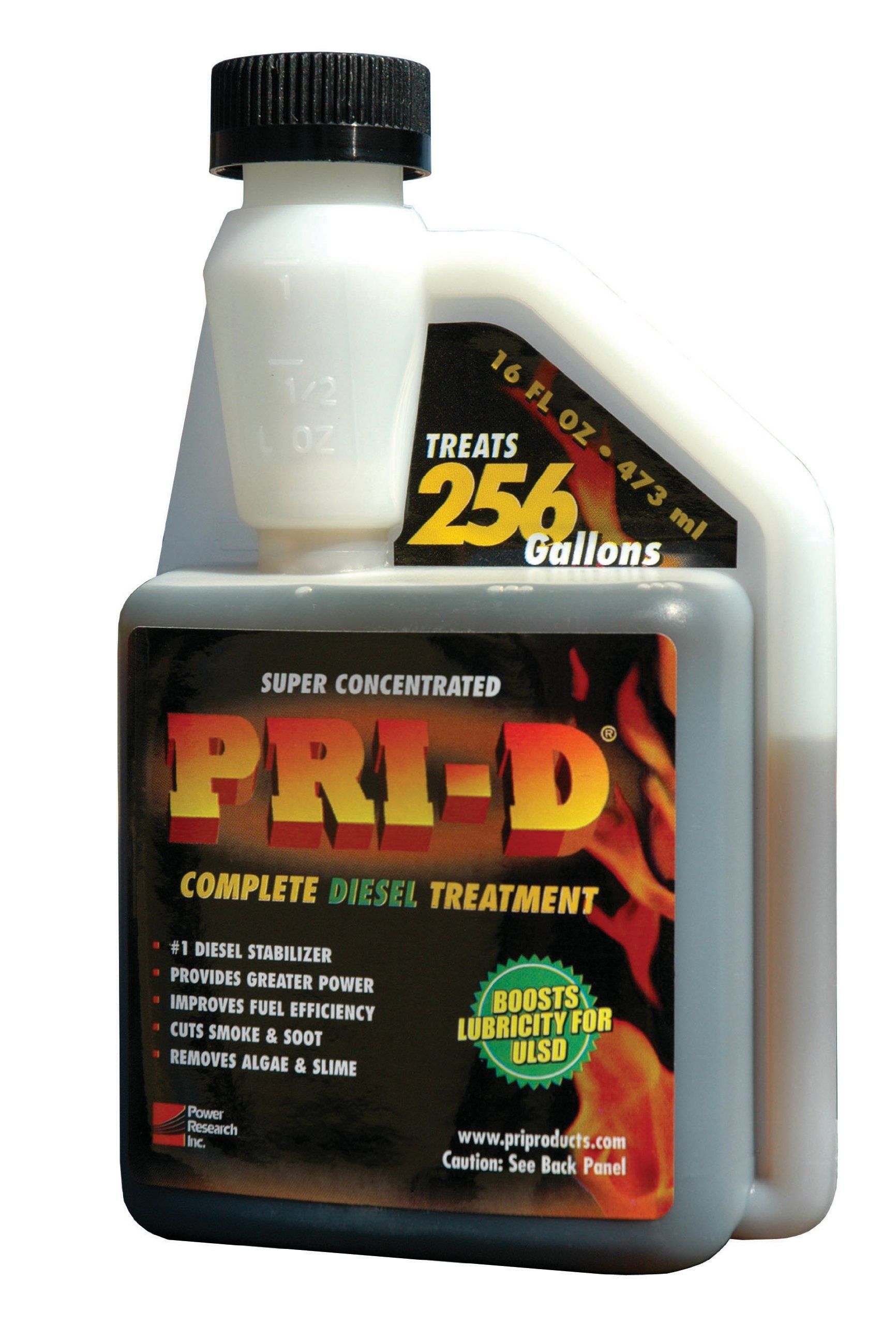
Antioxidant stabilizers work by donating electrons to interrupt the oxidation chain reaction — they don’t kill microbes and they don’t address water contamination. Products in this category typically contain hindered phenols, phenylenediamines, or similar antioxidant chemistry. STA-BIL Diesel and PRI-D (Power Research Inc.’s diesel formula) are the most widely stocked options at this tier. PRI-D gets consistent attention in long-term storage discussions for its claimed ability to restore partially degraded fuel — the manufacturer rates it for restoring fuel up to 8 years in storage, though independent verification of that outer limit is limited; what reviewers and operators consistently report is reliable 24-month protection on fresh fuel stored cool and full. STA-BIL Diesel’s published dosage is 1 oz per 5 gallons for storage up to 24 months; operators running warm-climate or high-headspace storage should treat that as a 12-month ceiling.
Biocides are a separate product category entirely. The active ingredient you’re looking for is an isothiazolinone compound or, more commonly for diesel, an oxazolidine or a combination product. The most widely cited and available option in the U.S. market is Biobor JF, which uses 2,2’-(1-methyltrimethylenedioxy)bis-(4-methyl-1,3,2-dioxaborinane) — a boron-based biocide — at a maintenance dose of 1 oz per 125 gallons or a kill-dose of 1 oz per 64 gallons for active infestations. Biobor JF has been a standard in aviation and marine diesel treatment for decades; Practical Sailor’s coverage consistently rates it as the reference-standard biocide for marine diesel applications, and the same chemistry applies to land-based storage. Note that Biobor JF is not an antioxidant stabilizer — it does not slow oxidation and should not be used as a substitute for a stabilizer in a dual-treatment protocol.
The dual-treatment protocol is the correct frame for any storage beyond 6 months:
- Treat with an antioxidant stabilizer at fill time (PRI-D or STA-BIL Diesel)
- Add a biocide at maintenance dose at fill time, and re-treat at the kill dose if contamination is detected
- Minimize headspace — full containers dramatically reduce oxygen exposure and condensation cycling
- Test for water with water-finding paste on a dip stick before treating; treat the water intrusion first, not after
NFPA 30 (Flammable and Combustible Liquids Code) doesn’t specify chemical treatment protocols but does govern container type, venting, and storage location requirements that intersect with your treatment effectiveness — a properly sealed, vented safety can or UN-certified steel jerry can minimizes the headspace and condensation cycling that makes stabilizers work harder. Container choice and chemical treatment are not independent variables.
Container Material, Headspace, and Treatment Effectiveness
The chemistry of stabilizer depletion is not linear — it’s driven by surface area exposure to oxygen and temperature cycling. A half-empty 55-gallon drum in a non-climate-controlled outbuilding is the worst-case scenario: large headspace, temperature swings that drive condensation, and a metal surface area that can catalyze oxidation. A full, sealed Wavian or Scepter NATO-spec 20-liter steel jerry can in a cool environment is close to ideal for small-volume storage.
For operators managing 50–300 gallons of backup diesel (generator fuel, agricultural equipment, off-road auxiliary tanks), the practical architecture is:
- UN-certified steel jerry cans (Wavian, Scepter MFC) for rotation inventory — fill, treat, rotate on a 12-month cycle
- UL-listed vented safety cans (Justrite, Eagle) or above-ground storage tanks rated for diesel for primary working inventory, with biocide at fill and antioxidant stabilizer at each top-off
- DC transfer pump systems (Fill-Rite FR1210G-class) with in-line filtration — filter condition is your cheapest real-time diagnostic for contamination; if filters are clogging fast, you have a microbial or sediment problem that treatment can manage but not reverse once severe
The Decision Rules
If you’re storing diesel for fewer than 6 months in a full, sealed container in a cool environment: a single antioxidant stabilizer at label dose is adequate. Skip the biocide unless you’re using biodiesel-blend fuel.
If you’re storing for 6–24 months, in any climate, or using B5+ blended diesel: dual-treat at fill time — stabilizer plus biocide, every time, no exceptions. PRI-D for the stabilizer (re-treat annually), Biobor JF at maintenance dose for the biocide.
If you’re managing more than 50 gallons, have a warm or humid storage environment, or are using tanks that have previously had contamination: treat the microbial problem first with a kill-dose biocide application, filter the tank output before using the fuel, and establish a quarterly dip-check with water-finding paste. Do not assume a stabilizer will mask an active infestation — it won’t.
If your fuel is already more than 12 months old and untreated: test it before using it on critical equipment. Dark color, sediment, or sour smell are disqualifying for injector-equipped engines. Siphon, filter, and evaluate — old diesel can sometimes be reconditioned for lower-stakes uses (non-injected equipment, controlled burns) but the cost of an injector rebuild outweighs the value of a drum of degraded fuel.
The core discipline is simple: stored diesel is a managed asset, not a passive stockpile. Treat it that way from the first fill, and the 24-month horizon is genuinely achievable. Ignore it, and six months is optimistic.