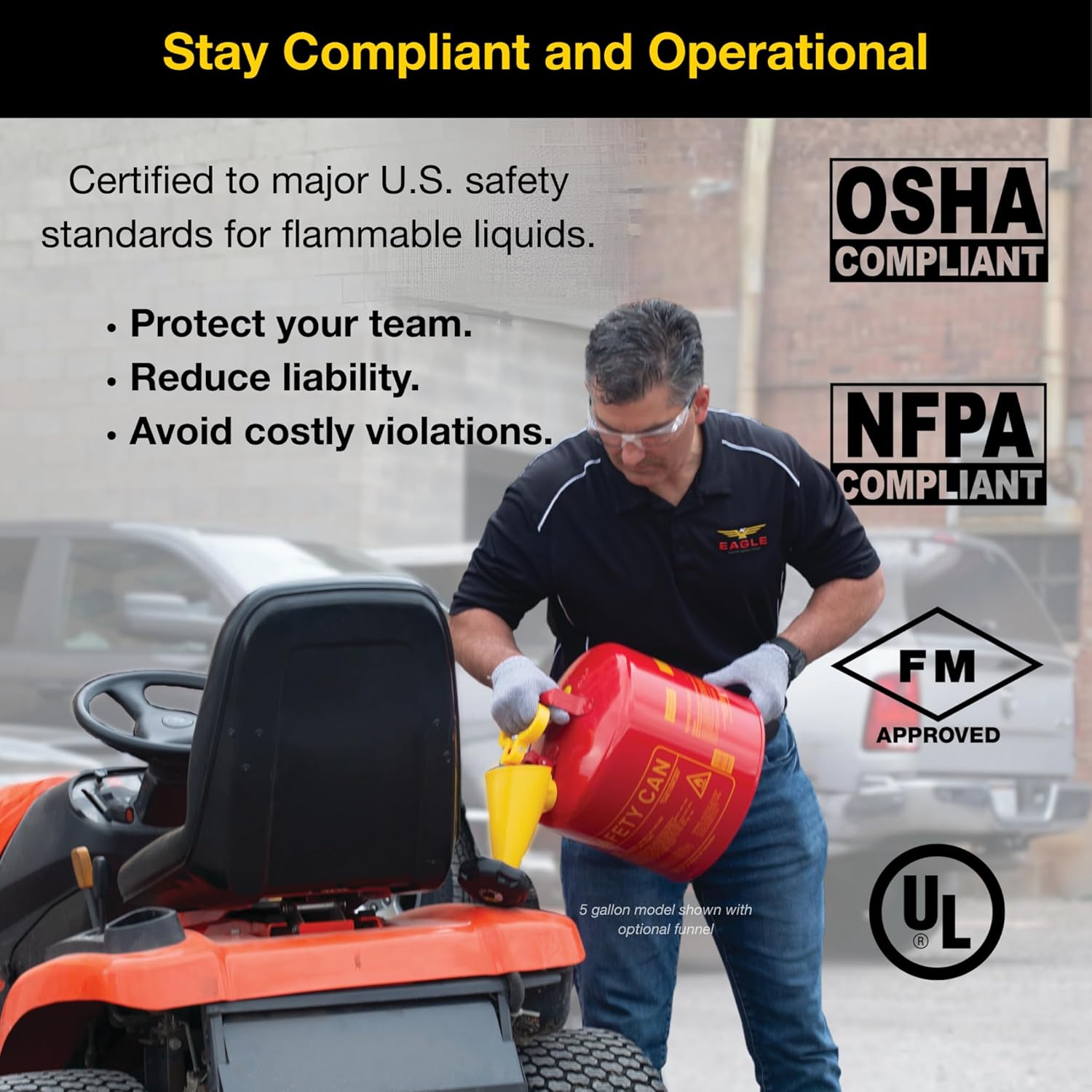
If you store gasoline, diesel, or other flammable liquids in a container outside a fixed tank, the container you choose is doing quiet but important safety work every time you open it. A safety can — as the term is used in fire codes and OSHA regulations — is not just any fuel container. It’s a certified metal vessel with a spring-loaded lid that closes automatically when released, a flame arrester (a fine-mesh screen inside the spout that prevents a flame from traveling back into the liquid), and a pressure-relief mechanism that vents vapor safely before it can build to dangerous levels. Two brands dominate the professional and serious-hobbyist market in the United States: Eagle Manufacturing and Justrite. Both carry the FM Approval mark — a certification from FM Global, one of the world’s most rigorous industrial testing and insurance organizations — meaning both have cleared the same baseline fire and vapor-management tests. But FM approval is a floor, not a ceiling. The arrester design, lid feel, weld quality, and long-term corrosion resistance between these two brands differ enough that choosing the wrong one for your application is a real, if quiet, cost. This article walks through exactly where they diverge.
| EDITOR'S PICKEagle 5 Gallon Type I Yellow Sa… | Mid-tierEagle 5 Gallon Type I Red Safet… | Budget pickEagle 2 Gallon Type I Red Safet… | |
|---|---|---|---|
| Capacity | 5 gal | 5 gal | 2 gal |
| Fuel type | Diesel | Gasoline | Gasoline |
| Color | Yellow | Red | Red |
| Funnel included | ✗ | ✓ | ✓ |
| Price | $84.79 | $71.61 | $64.35 |
| See on Amazon → | See on Amazon → | See on Amazon → |
What FM Approval Actually Certifies (And What It Doesn’t)
FM Global’s FM 6050 approval standard for flammable and combustible liquid storage containers requires that a certified safety can survive a flash-fire test with the arrester installed, demonstrate that the self-closing lid closes reliably under load, and prove the pressure-relief mechanism activates within safe limits. Per FM Global’s published FM 6050 standard documentation, cans must also be constructed of steel with adequate gauge to resist puncture during normal handling.
That’s meaningful. It rules out the vast majority of plastic fuel jugs, which cannot pass flame arrester requirements. What FM 6050 does not mandate is a specific arrester mesh count, a minimum lid-spring tension standard, or a corrosion-resistance specification beyond the base material. This is where Eagle and Justrite start to diverge in ways that matter to practitioners.
OSHA’s regulation 29 CFR 1910.106 — Flammable Liquids — cross-references FM and UL (Underwriters Laboratories UL 30 Standard for Metal Safety Cans) approval as acceptable compliance pathways for safety cans used in the workplace. Both Eagle and Justrite maintain both approvals. NFPA 30, the Flammable and Combustible Liquids Code (2024 edition), similarly treats FM-approved safety cans as compliant vessels for Types I and II applications. In environments where NFPA 30 compliance is inspected — commercial garages, fleet maintenance shops, certain agricultural operations — you should confirm your can’s current approval status directly from the manufacturer’s specification sheet, since approval listings are periodically re-audited.
The practical takeaway: FM approval tells you both cans clear the minimum bar. It does not tell you which arrester holds up in wet-humid storage, which lid spring fatigues faster, or which pour spout creates less static risk in high-volume use. Those are specification and real-world-use questions, not certification questions.
Flame Arrester Design: Where the Real Differences Live
Eagle’s Stainless Mesh and Replaceable Arrester Design
Eagle’s Type I and Type II steel safety cans — sold under the 4000-series and CAN-series product lines — use a stainless-steel mesh flame arrester pressed into the spout assembly. Per Eagle Manufacturing’s published product specification sheets for the Type I and Type II Safety Cans (Series 4000 and CAN), the arrester is a replaceable, separate component on most models. If the mesh becomes clogged with varnish residue from stale gasoline, or is physically damaged from rough handling, you can replace the arrester element without replacing the entire spout assembly or the can itself. The spout is galvanized steel, and operators in long-run maintenance contexts report that the pressed-fit arrester stays secure even after repeated pour cycles.
Eagle’s Type I design is configured for a single-opening upright pour. Their Type II adds a separate vent opening — relevant when decanting into equipment that benefits from incoming air to balance internal pressure during dispensing. Eagle’s lid-closing mechanism uses a relatively stiff spring by design; operators in colder climates note that the deliberate tension improves confidence that the lid is actually seating fully after each use.
Eagle
$71.61
In stock on Amazon
Check price on AmazonJustrite’s AccuFlow Flexible Spout System
Justrite’s differentiating feature is its AccuFlow and AccuFlow 2.0 spout system, documented in Justrite Manufacturing’s AccuFlow and AccuFlow 2.0 Safety Can Technical Documentation (2024). The AccuFlow design routes the pour through a flexible, duckbill-style spout that can be repositioned to reduce spill risk on awkward fills — a genuine ergonomic advantage over rigid spouts when pouring into a recessed filler neck on a generator or a low-clearance marine tank. The flame arrester in Justrite cans is integrated into the spout assembly rather than being a standalone replaceable element; if the arrester is damaged or clogged, Justrite’s published guidance calls for replacing the full spout assembly rather than the mesh element alone.
Justrite’s lid mechanism uses a slightly lighter spring tension than Eagle’s comparable models. Reviewers in maintenance-context evaluations describe it as easier to operate with one hand, though occasionally less definitive in feel when the lid is fully seated. Justrite offers a wide SKU range with FM-approved Type II configurations available up to 5-gallon capacity in standard retail and industrial supply formats.

Eagle
$84.79
In stock on Amazon
Check price on AmazonSide-by-Side Specification Summary
| Feature | Eagle (4000 / CAN Series) | Justrite (AccuFlow) |
|---|---|---|
| Arrester material | Stainless steel mesh | Stainless steel mesh |
| Arrester serviceability | Replaceable standalone element | Spout-assembly replacement |
| Spout type | Rigid galvanized steel | Flexible AccuFlow duckbill |
| FM + UL dual approval | Yes (FM 6050 / UL 30) | Yes (FM 6050 / UL 30) |
| Available Type II | Yes, 1–5 gal | Yes, 1–5 gal |
| NFPA 30 compliant | Yes | Yes |
| Lid spring tension | Stiffer / more deliberate | Lighter / easier one-handed |
Eagle
$64.35
In stock on Amazon
Check price on AmazonReal-World Durability: Steel Gauge, Weld Quality, and Corrosion Patterns
Both brands build their standard safety cans from 24-gauge cold-rolled steel with a galvanized or zinc-plated finish. Operators in long-cycle use contexts — fleet maintenance, construction site storage, and agricultural fuel management — report a consistent pattern: Eagle cans tend to develop surface rust at the lid spring pivot point before the body shows significant wear, particularly in humid or coastal environments where the can is stored outdoors under a tarp rather than in a conditioned space. Justrite cans show a similar vulnerability at the spout hinge point under the same conditions.
What differentiates them over time is the weld seam. Eagle’s manufacturing reputation, reflected across aggregated industrial supply channel reviews, leans toward heavier weld seams. Operators report fewer instances of seam weeping — where fuel slowly migrates through a stress point in the weld — over a five-year-plus service cycle. Justrite’s welding is considered comparable in controlled environments but draws more comments about seam integrity in applications with significant thermal cycling, where a can is repeatedly exposed to direct sun and then shade, expanding and contracting the steel over time.
Neither brand’s can is designed for indefinite outdoor storage. FM Global’s FM 6050 documentation and NFPA 30 (2024 edition) both identify UV exposure, thermal cycling, and moisture as primary degradation vectors for safety can integrity over time. If outdoor or semi-exposed seasonal storage is your operating reality — common for rural property owners managing generator fuel between uses — Eagle’s weld-seam construction gives it a marginal edge in the long-tail durability comparison.
One additional factor: finish type. Eagle’s standard exterior is a red enamel paint. Justrite’s standard finish is also red enamel on most models, with powder-coat options on higher-tier industrial SKUs. Powder coat holds up noticeably better to solvent splash — relevant when managing multiple fuel types in close proximity. On premium Justrite models, the powder-coat exterior extends appearance and corrosion resistance compared to standard enamel on either brand.
Fitting Compatibility and Dispensing Accessories
If you’re integrating a safety can into a larger dispensing setup — using it with a hand pump, a 12V transfer pump intake, or a drum cradle — fitting compatibility is a practical decision point that neither brand’s marketing materials make obvious.
Eagle’s standard opening on Type II cans uses a ¾-inch NPT threaded bung on the secondary opening, which is the most common thread standard in U.S. liquid-transfer fittings. This mates well with most hand-pump adapters and with the intake hose adapters on common 12V DC transfer pumps used for diesel and gasoline dispensing in agricultural and fleet contexts.
Justrite’s Type II secondary opening uses the same ¾-inch NPT standard on most gasoline and diesel safety can models, but it’s worth verifying against the specific SKU — some of Justrite’s specialty solvent can configurations use a different opening geometry. For standard fuel cans in Type I and II format, NPT compatibility is consistent across the main product line.
Neither brand’s safety can is designed as a primary fill source for high-volume pump setups — those applications typically call for larger vessels such as NATO-specification steel jerry cans, Moeller marine fuel cells, or drum configurations. For supplemental manual dispensing, Eagle’s rigid spout mates more cleanly to standard pour-spout accessories without adapters, while Justrite’s AccuFlow flexibility requires a straight-spout adapter when threading the pour into a narrow-neck fuel-tank filler.
Decision Framework: Matching the Can to the Context
You’re at a decision point. Here is how to read the tradeoffs honestly.
If your primary use is OSHA-regulated workplace or job site compliance: Both cans qualify under OSHA 29 CFR 1910.106. Justrite’s broader SKU availability through major industrial supply channels and its well-documented FM/UL dual-approval specification sheets make it straightforward to pull current documentation for an inspection. Advantage: Justrite.
If you’re managing long-cycle seasonal fuel storage outdoors or in a humid environment: Eagle’s heavier weld-seam construction and user-replaceable arrester give it a real advantage when you’re not servicing the can on a frequent schedule. A clogged arrester you can replace for a few dollars beats one that requires a full spout-assembly swap. Advantage: Eagle.
If ergonomic one-handed pouring is a genuine operational need — generator filling in a tight enclosure, marine tank filling from a moving deck, or any situation where your free hand is occupied or the filler neck is in an awkward position — Justrite’s AccuFlow duckbill spout is the practical answer. Advantage: Justrite.
If you’re building a dispensing setup that integrates with existing NPT accessories: Eagle’s rigid spout mates more directly to standard pour-spout accessories without adapters or transitions. Advantage: Eagle.
On price: Both brands land in the $30–$65 range for 1–2.5 gallon FM-approved steel safety cans at current retail pricing. At equivalent volumes, Eagle typically prices $3–$8 lower than Justrite at major industrial supply retailers. For a homeowner buying one or two cans, that gap is not decisive. For a fleet buyer specifying 20 or more units, it accumulates.
The short version: Justrite wins on ergonomics and commercial-channel availability. Eagle wins on arrester serviceability and long-cycle weld durability. Neither wins on both. If you’re buying one can for a garage and you regularly pour into awkward or recessed fills, get the Justrite. If you’re stocking multiple cans for seasonal diesel or gasoline management and want a more field-serviceable design with a longer outdoor-storage track record, Eagle earns the nod.