If you’re storing diesel for farm equipment, gasoline for a generator bank, or fuel for a small fleet of work trucks, moving that fuel efficiently and safely requires more than a siphon hose and a prayer. A transfer pump is a dedicated device — electric or battery-powered — designed to move fuel from a large storage tank into a vehicle, equipment tank, or portable container at a controlled flow rate. Fill-Rite, a brand under Tuthill Corporation, is the most recognized name in this category in North America: their pumps ship with published specification sheets, consistent certification documentation, and a parts ecosystem that makes long-term ownership practical. This guide answers the specific question that trips up most buyers — should you run 115V AC power or 12V DC, and do you need the meter kit? We’ll show the math, name the tradeoffs explicitly, and close with clear decision rules organized by use case so you can stop second-guessing and spec the right system.
| EDITOR'S PICK[Fill-Rite FR701V 115V 20 GPM Fu…](https://www.amazon.com/dp/B000KKLKCM?tag=greenflower20-20) | Mid-tier[Fill-Rite FR604H 115V 15 GPM Fu…](https://www.amazon.com/dp/B00CXG3DB2?tag=greenflower20-20) | Budget pick[Fill-Rite FR1204H 12 V 15 GPM F…](https://www.amazon.com/dp/B00B5RDWD4?tag=greenflower20-20) | |
|---|---|---|---|
| Power source | 115V AC | 115V AC | 12V DC |
| Flow rate | 20 GPM | 15 GPM | 15 GPM |
| Meter included | ✓ | ✗ | ✗ |
| Price | $1,019.99 | $474.99 | $369.99 |
| See on Amazon → | See on Amazon → | See on Amazon → |
The Core Split: 115V AC vs. 12V DC
This isn’t a marketing distinction. The power source changes nearly every downstream decision: installation complexity, flow rate, location flexibility, and long-term operating cost. The comparison below is organized into three tiers so you can find your situation quickly.
H3: Fixed Installation Near a Structure (115V AC)
Fill-Rite FR700V series — the benchmark 115V pump — is designed to run off standard North American single-phase outlet power, the same 15- or 20-amp circuit you’d find in a barn, shop, or fuel shed. According to the FR700V product specification sheets published by Tuthill Corporation, peak rated flow is approximately 15 GPM on gasoline and diesel, with sustained real-world flow running closer to 12–13 GPM depending on hose length and vertical lift. At 12 GPM, a 100-gallon tank fills in roughly 8 minutes — meaningful when you’re fueling four to six tractors in a single morning.
The tradeoff is straightforward: you need a power outlet within reach of your storage tank. Running a 120V circuit to a remote tank location involves conduit, breaker capacity, and — near flammable liquids — compliance with NFPA 30 (Flammable and Combustible Liquids Code, National Fire Protection Association) and OSHA Standard 1910.303 (Electrical Safety, U.S. Department of Labor). Inspectors do look at this. If your tank already sits near a structure with power, 115V is almost always the better call: higher sustained flow, no battery maintenance, and cleaner long-term ownership.
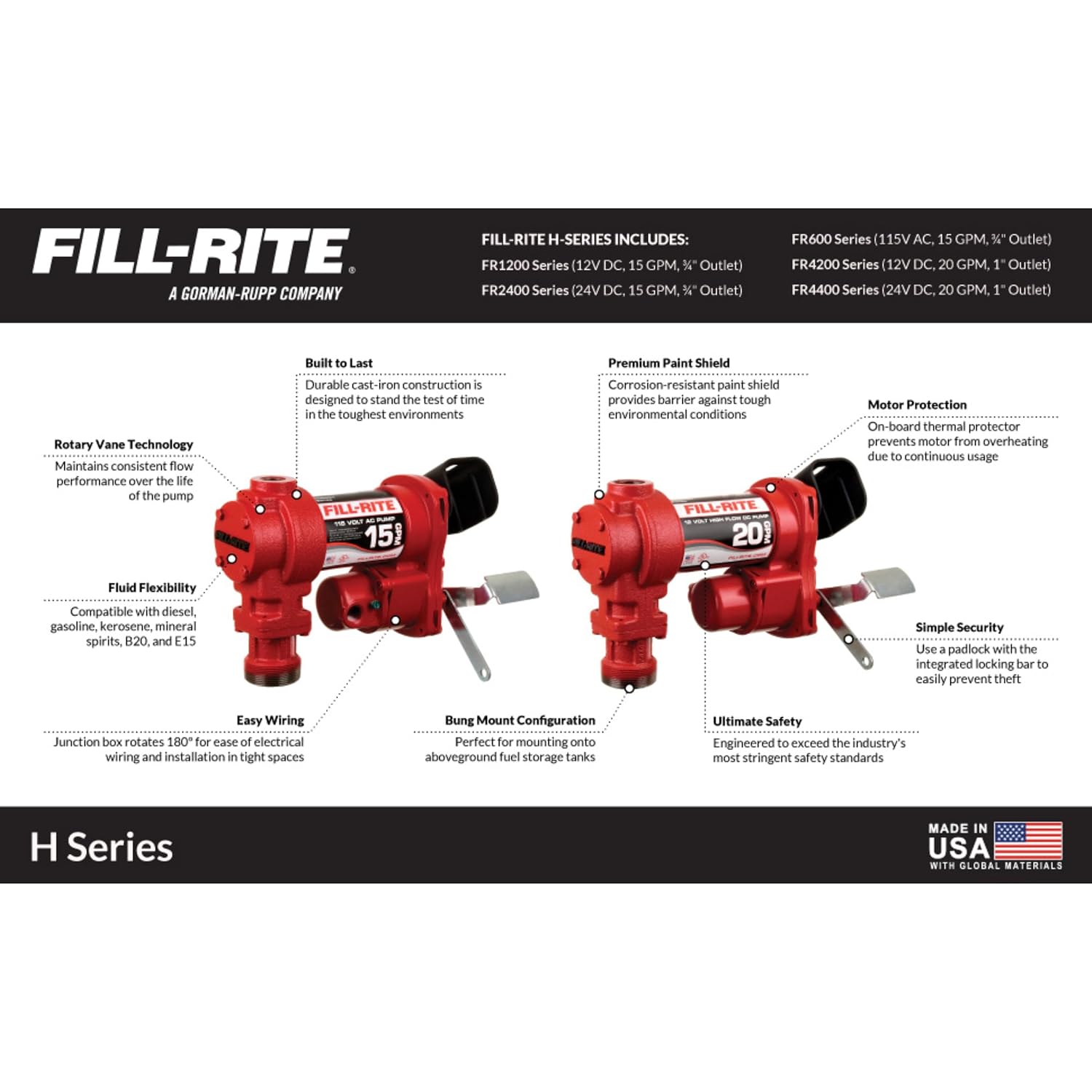
Fill-Rite
$474.99
In stock on Amazon
Check price on AmazonH3: Remote, Mobile, or Truck-Bed Fueling (12V DC)
Fill-Rite FR1210G — arguably Fill-Rite’s most recognized SKU — draws power from any 12-volt battery source: a vehicle’s starting battery, a standalone deep-cycle battery, or a dedicated battery box. The FR1210G product specification sheet from Tuthill Corporation rates the pump at 15 GPM peak, with operators in long-run agricultural deployments reporting sustained flow in the 10–13 GPM range once hose friction and battery state are factored in. That’s still fast enough for most farm-to-fleet applications.
The 12V system earns its place in two scenarios: when you’re fueling from a truck bed where no outlet is available, and when your storage tank is located far from any structure. A dedicated deep-cycle battery with a 5-amp trickle charger is a workable permanent installation. The downside is long-term battery maintenance — something that 115V setups simply don’t require. Budget for the trickle charger if the truck isn’t running during every transfer session.
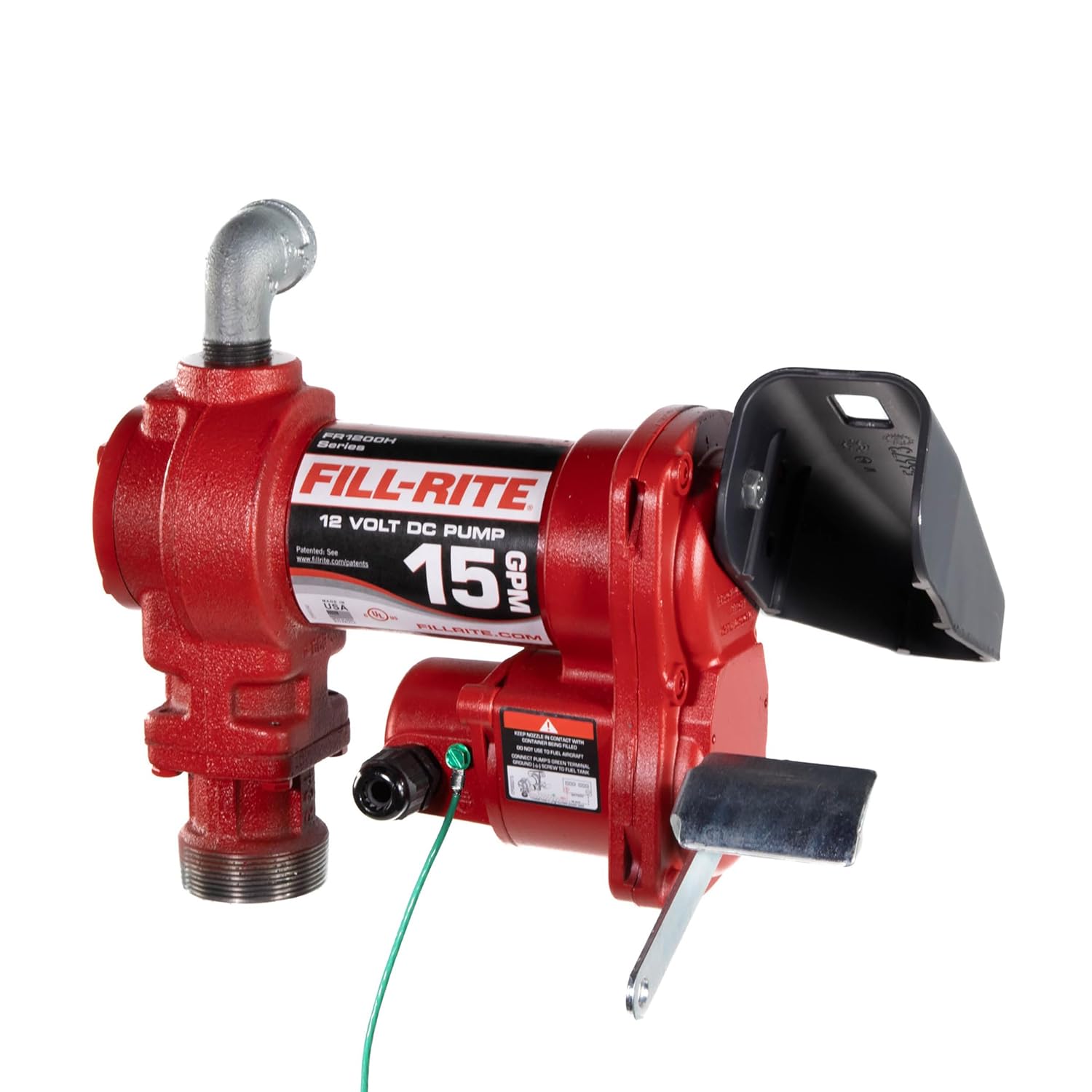
Fill-Rite
$369.99
In stock on Amazon
Check price on AmazonH3: High-Volume Fleet Bays With Documentation Requirements (115V AC + Meter Package)
For operations fueling multiple vehicles daily across multiple cost centers — a small municipal fleet, a large row-crop operation with hired operators, or a contractor pool — the 115V pump paired with a meter package is the appropriate configuration. The meter adds $80–$150 to the system cost depending on the package and whether you choose a mechanical nutating-disc meter or a digital display unit. That cost is justified when you need verifiable fuel inventory records. The EPA’s Spill Prevention, Control, and Countermeasure (SPCC) Rule guidance (U.S. Environmental Protection Agency) notes that facilities above certain aggregate fuel storage thresholds are required to maintain accurate fuel inventory records — and an eyeball estimate from a sight gauge won’t satisfy a compliance inspection.
One additional note applies here: if you’re considering selling fuel to neighbors, subcontractors, or business partners — even informally — NIST Handbook 44 (Specifications, Tolerances, and Other Technical Requirements for Weighing and Measuring Devices, National Institute of Standards and Technology) governs commercial fuel measuring devices in most U.S. states. Standard Fill-Rite meter packages are not NIST-certified for commercial sale. You’ll need a separately sourced, calibrated commercial meter for that use case. Know which side of that line you’re on before purchasing.
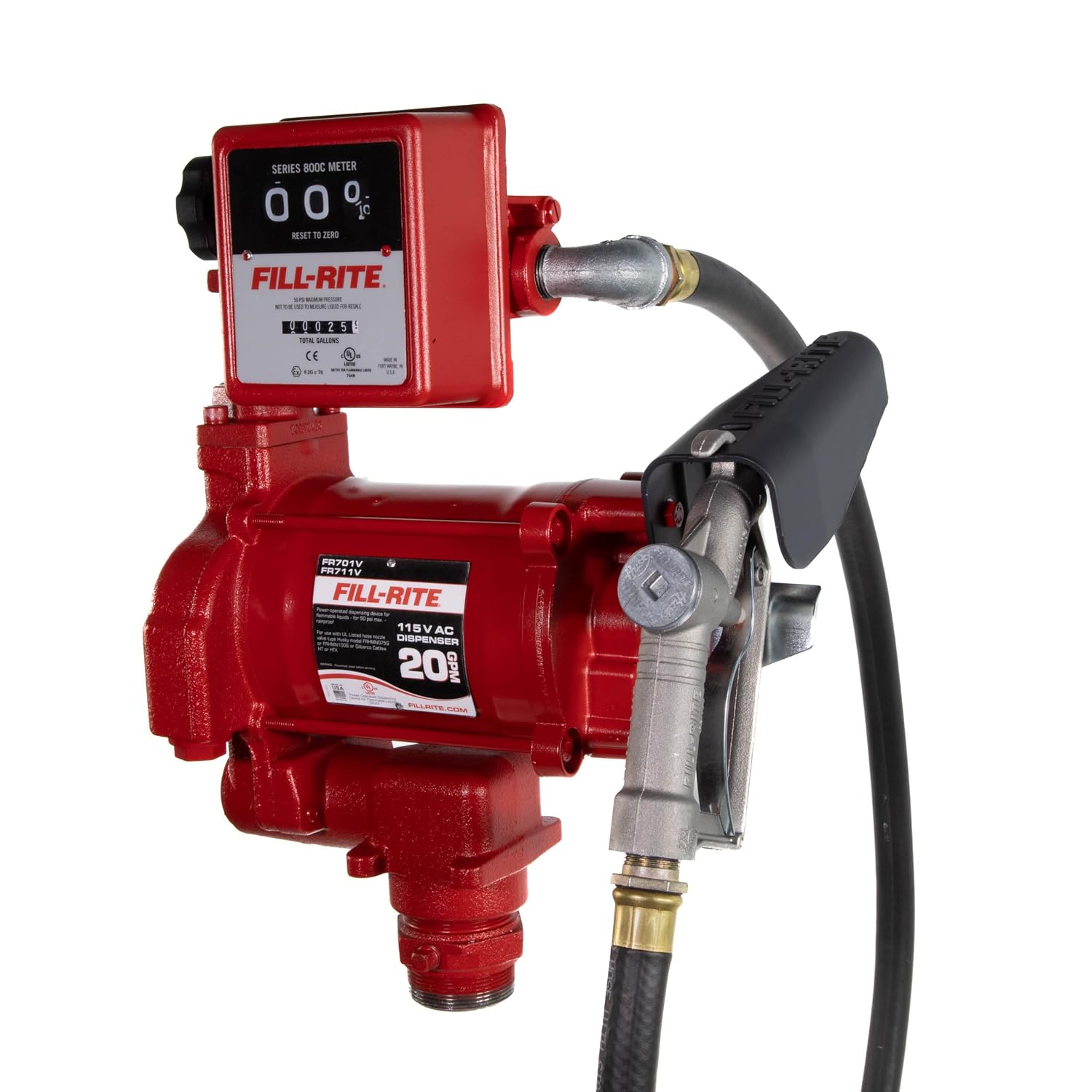
Fill-Rite
$1,019.99
In stock on Amazon
Check price on AmazonMeter Packages: When the Accuracy Math Pencils Out
Fill-Rite sells both the FR700V and FR1210G as standalone pumps and as meter packages that bundle an inline fuel meter — typically a nutating-disc positive-displacement type — onto the outlet side of the pump. The question isn’t whether meters are accurate when calibrated; the question is whether your use case justifies the added cost.
Three scenarios where the meter package consistently pays back its price:
Multiple operators sharing a tank. A farm with employees fueling equipment from a common storage tank, or a fleet where you’re tracking per-vehicle consumption for maintenance records or tax reporting, needs verifiable data. Without a meter, you’re estimating from a sight gauge. The EPA SPCC Rule guidance referenced above identifies accurate fuel inventory recordkeeping as a compliance requirement at larger storage volumes.
Fuel stabilizer dosing at scale. This is where the meter delivers compounding value that’s easy to miss. If you’re treating diesel with a biocide or adding a stabilizer like STA-BIL 360 Diesel for seasonal storage, accurate volume measurement is the only way to dose correctly. Most stabilizer manufacturers specify dosing rates by gallon, not by tank. Overdosing wastes money; underdosing leaves you with microbial growth or water-phase separation by spring. Operators managing 500-gallon or larger seasonal storage tanks consistently report that the meter package paid for itself in stabilizer savings within two seasons.
Any regulatory documentation requirement. If your operation is subject to EPA SPCC oversight, or if your state agriculture department requires fuel consumption records for farm diesel tax exemption claims, a meter is the most defensible documentation tool available at this price point.
When to skip the meter: Single-operator fueling from a personal tank with no billing requirement and no regulatory documentation obligation. Put the savings toward a quality hose assembly with a spring-guard whip end, or an inlet filter housing — both of which have more immediate impact on daily operation.
Installation Details That Determine Whether the System Actually Works
This is where buyers with six to twelve months of experience get tripped up — not on pump selection, but on the installation specifics that control real-world performance.
Suction lift limits. Fill-Rite’s published specification sheets for both the FR700V and FR1210G list maximum suction lift at approximately 5–6 vertical feet from the fuel surface to the pump inlet. Exceed that measurement and flow rate drops noticeably; sustained operation above the rated lift risks cavitation and accelerated wear on the pump’s internal vanes. If your tank is underground or your pump is mounted high on a wall above the tank outlet, measure that vertical distance before finalizing pump placement. Tuthill’s spec sheets include suction lift derating curves — worth reviewing for any installation that isn’t pump-at-grade next to an above-ground tank.
Hose and fitting compatibility. Fill-Rite pumps use standard NPT (National Pipe Thread) fittings at the inlet and outlet — typically 3/4-inch NPT. This matters when sourcing third-party hose assemblies, nozzles, or filter/water-separator housings. NPT is the dominant standard in North American fuel applications but is not interchangeable with BSPP (British Standard Parallel Pipe) fittings, which appear on some imported equipment and certain marine components. A mismatched fitting will leak under pressure and create a genuine fire hazard. Confirm thread standard before assembling anything.
Grounding and bonding. NFPA 30 (National Fire Protection Association) and OSHA Standard 1910.144 (U.S. Department of Labor) both address static electricity accumulation during fuel transfer — a real ignition risk with gasoline in particular. Standard practice is to bond the container being filled to the storage tank using a bonding wire clipped to both metal surfaces before transfer begins, and to ground the pump system to earth. Fill-Rite’s installation documentation covers this procedure; it is not optional and it is not overcautious. Agricultural fleet operators consistently identify skipped bonding as the most common installation shortcut — and the one most frequently cited in insurance claims following fuel fire incidents.
Inlet filtration. If your storage tank is more than a year old, or if you have any reason to suspect water intrusion, a 10-micron filter/water separator on the inlet side of the pump is worth the $40–$80 it adds to system cost. Debris and suspended water are the primary causes of early pump wear in agricultural deployments. This component is not included in any standard Fill-Rite kit, but it’s a first-recommendation addition from fleet maintenance professionals managing multi-unit operations.
Decision Rules: If X, Then Y
You’ve read the analysis. Here’s how to convert it into a purchase decision.
Tank within 50 feet of a structure with 115V power → spec the FR700V 115V system. Higher sustained flow, no battery maintenance, lower long-term ownership complexity. Add the meter package if you have multiple operators, any billing requirement, or a regulatory documentation obligation.
Tank is remote, mobile, or mounted in a truck bed → spec the FR1210G 12V system. Budget for a dedicated deep-cycle battery and a 5-amp trickle charger if it’s a fixed installation. Skip the trickle charger only if the source vehicle runs during every transfer session.
Dosing fuel stabilizer for seasonal storage at 100+ gallons → add the meter package regardless of which pump you choose. Dosing accuracy pays back the price difference in stabilizer waste prevention within two seasons at typical storage volumes.
Considering billing fuel to other parties → verify your state’s requirements under NIST Handbook 44 (National Institute of Standards and Technology) before purchasing. A standard Fill-Rite meter package is not NIST-certified for commercial sale in most jurisdictions. You may need a separately calibrated commercial meter.
Tank is older or water contamination is possible → add an inline filter/water separator on the inlet side before first use. The pump warranty does not cover debris damage, and replacement pump internals cost nearly as much as a new unit.
The Fill-Rite product line is deep enough that there is a correct configuration for nearly every farm-to-fleet application. The goal is buying that configuration the first time — because a pump return is a multi-day logistics problem when equipment needs to be fueled tomorrow morning.