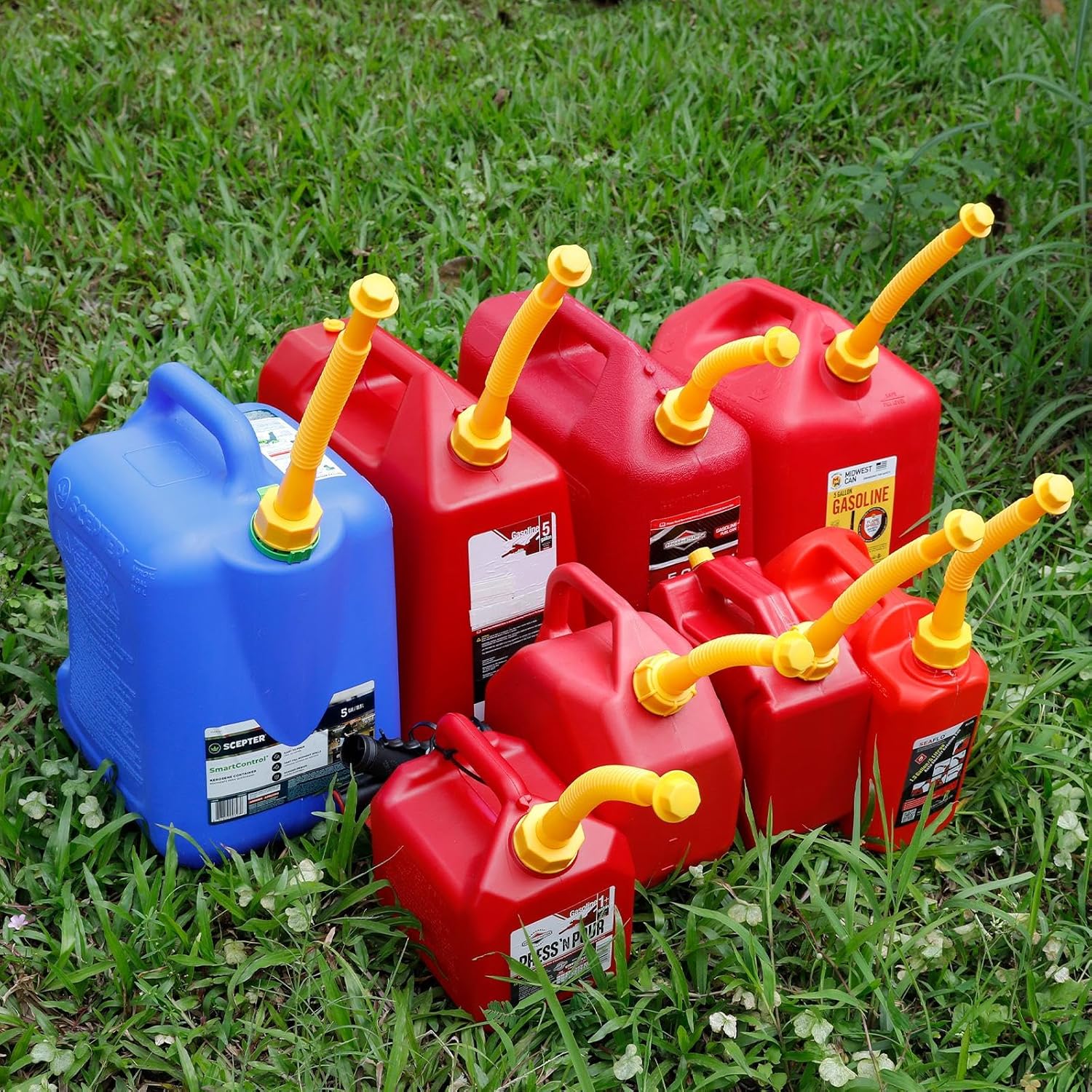
If you have a gas can sitting in the garage right now with a cracked spout, a missing vent cap, or a nozzle that drools fuel every time you tilt the can, you’re in a surprisingly complicated replacement situation. A gas can spout is the entire pour assembly — the tube, the nozzle tip, any automatic shut-off or anti-glug valve, and the cap that threads onto the can’s opening. Since 2009, federal EPA rules have required that almost all portable fuel containers sold in the U.S. use a no-spill or spill-proof spout design — one that only opens when pressed against a filler neck, preventing vapors and liquid from escaping at any other time. That sounds straightforward until you need to replace just the spout and discover that thread sizing, vent configurations, and cap diameters vary enough between brands that a kit bought at random has a real chance of leaking worse than the one you threw away. This guide maps the actual decision points: what the EPA compliance requirement means in hardware terms, how to read thread specs so you buy a spout that fits your can, and which replacement kits have a track record of sealing reliably across the long haul.
What EPA No-Spill Compliance Actually Means for Hardware
The 2009 EPA portable fuel container rule — built on top of California Air Resources Board standards that preceded it — does not regulate the can itself so much as the spout system’s vapor emissions. The core requirement is that a compliant spout must remain closed (no liquid flow, minimal vapor permeation) until deliberately actuated against a receiving tank. In practice that means one of two mechanisms:
Automatic shut-off (ASO) nozzles use a spring-loaded tip that stays sealed until external pressure — your hand pressing the nozzle into a fuel inlet — depresses it. Brands like Scepter’s Smart Control Spout and Briggs & Stratton’s no-spill kits use this approach. The advantage: you can invert the can without flow starting. The disadvantage: you need both hands for controlled pours into small filler necks, and the spring tension wears over time.
Positive-close valves require the user to open the valve before pouring and close it afterward, but the valve is deliberately designed to resist accidental opening from can pressure or vibration. Pre-2009 “old-style” spouts lacked this — they relied on a separate vent hole that stayed open during storage, which is why they dripped at rest and off-gassed freely in a hot truck bed.
What you cannot legally buy new is a pre-EPA one-way tube spout with an open vent hole — the kind that worked with a separate vent cap you’d loosen to pour. Those were phased out under the federal rule. Aftermarket kits that replicate the old open-vent design still circulate on marketplace sites, and they’re technically non-compliant for sale in the U.S., though EPA enforcement targets manufacturers rather than end users. OSHA’s portable container guidance notes that vapor control at the spout level is a meaningful component of workplace flammable-liquid safety — so the compliance concern isn’t purely bureaucratic.
Thread Sizing: NPT, BSPP, and Why the Two Don’t Mix
This is where most replacement purchases fail. A gas can’s fill opening — the threaded neck the spout cap screws onto — follows one of two thread standards, and they are not interchangeable:
NPT (National Pipe Taper) is the U.S. standard. The thread diameter tapers slightly along its length, which creates a mechanical seal as you tighten — no gasket required for a liquid-tight connection. Most plastic consumer cans sold in North America (Scepter, Briggs & Stratton, Midwest Can, Blitz-era containers) use NPT openings. The most common sizes for portable fuel containers are ¾-inch NPT and 1-inch NPT, with ¾” dominating the 1–5 gallon plastic can market.
BSPP (British Standard Pipe Parallel) is used by most European steel containers, including Wavian’s NATO-spec jerry cans and many Scepter MFC (Military Fuel Container) variants. BSPP threads are parallel — no taper — and rely on a face seal (O-ring or bonded washer) rather than thread engagement for the seal. A ¾-inch NPT cap will start threading onto a BSPP neck because the diameter is close, but it won’t seal; it’ll feel snug and then leak around the threads under pressure.
By the numbers — common portable fuel container thread specs:
| Container Type | Typical Thread | Cap OD (approx.) |
|---|---|---|
| U.S. plastic 1–5 gal (Scepter, Midwest) | ¾” NPT | ~1.05 in |
| U.S. steel safety can (Eagle, Justrite) | ¾” or 1” NPT | ~1.05–1.32 in |
| NATO/Wavian steel jerry can | BSPP (varies) | ~1.0 in parallel |
| Scepter MFC military-spec | BSPP + O-ring face seal | ~1.0 in parallel |
The practical fix: measure or look up your can’s neck thread before ordering. Most U.S.-market replacement spout kits (EZ-Pour, Surecan, No-Spill brand kits) are spec’d for ¾” NPT and will state this in their product listings. For NATO-format steel cans, purpose-made spout assemblies — or the factory-spec nozzle kits sold by Wavian’s U.S. distributor — are the right path, not a generic hardware-store replacement.
Popular Mechanics’ gas can product guide notes that thread mismatch is one of the two most common reasons replacement spout kits receive negative reviews, the other being spring-tension degradation in ASO nozzles within 18–24 months of regular use.
Which Kits Have a Track Record of Actually Sealing
A few replacement spout systems have established enough market presence that aggregated owner feedback provides a meaningful signal on real-world sealing performance:
No-Spill brand replacement kits (compatible with their own cans and most ¾” NPT plastic containers) consistently get high marks from owners for the base O-ring seal between the cap and can neck. The ASO tip mechanism is rated for the application; reviewers in long-run accounts note that the tip seal holds up reliably for 2–3 seasons of regular use before requiring a replacement tip — and tip-only replacements are available, which matters for cost of ownership on a container you’re keeping for a decade.
EZ-Pour universal spout kits take a different approach: they use a flexible tube with a positive-close thumb valve rather than an ASO spring tip. This design solves one persistent complaint about spring-tip nozzles — that you need to press the tip firmly against the filler neck, which is awkward on recessed inlets like some small engine tanks. Operators in overlanding forums consistently describe the EZ-Pour as easier to use one-handed on uneven terrain. The trade-off is that the thumb valve requires deliberate close-out; if you set the can down without closing it, it can drip. Per ASTM F852 language on portable container closures, positive-close designs are compliant as long as the valve remains in the closed position by default — which the EZ-Pour’s spring return handles.
Surecan’s self-venting spout system integrates a separate vent tube into the spout assembly, which is worth discussing because it solves the biggest ergonomic complaint about no-spill designs: the glug. Pre-EPA vented cans poured smoothly because air could enter the can as fuel left. No-spill spouts without a vent tube create a vacuum that causes fuel to pulse and slosh. Surecan’s dual-tube design — one tube for fuel out, one for air in — produces a consistent pour flow that owners report feels noticeably more controlled for precision fills. The downside: the assembly is bulkier and the can-side fitment is proprietary, meaning you can’t retrofit a Surecan spout to a Midwest Can or a Scepter; it requires a Surecan container.
Midwest Can replacement spout kits are the value-tier option. Published specs show ¾” NPT compatibility with their own containers and most same-standard plastic cans. Owner feedback is generally positive for basic sealing but notes that the ASO tip spring shows wear faster than No-Spill’s equivalent — roughly 1–2 seasons versus 2–3 — under frequent use (weekly generator refueling, regular lawn equipment cycles). For seasonal or low-frequency use, the cost delta is negligible. For operators filling equipment multiple times weekly, the difference in replacement frequency adds up.
Vent Caps, Anti-Siphon Valves, and the Parts Most People Ignore
A complete spout system includes more than the pour nozzle. Two components deserve explicit attention:
Vent caps: Many no-spill spout kits include a vent cap that replaces the separate vent hole found on older containers. On a compliant system, the vent cap should be a sealed plug — not a functional vent in the old sense — because the no-spill spout itself manages pressure through its valve geometry. If a replacement kit ships with a vent cap that has an open hole or a loose rubber flap, that’s a signal the design predates the 2009 EPA rule or was engineered for non-U.S. markets.
Spout-to-can gaskets: The flat gasket (or O-ring) between the spout’s base cap and the can’s threaded neck is the primary static seal — it’s the seal that prevents dripping when the can is in storage or transport. NFPA 30’s portable container provisions emphasize that static seals must be compatible with the fuel type (gasoline degrades some rubber compounds; ethanol-blend fuels — E10, E15 — are more aggressive). Kits specifying fuel-resistant nitrile (NBR) or Viton gaskets are appropriate for E10 use; generic rubber or PVC gaskets may swell or compress permanently within a season of regular contact with ethanol-blend gasoline.
OSHA’s flammable liquids guidance on portable containers reinforces that container integrity — including spout seals — is part of the broader obligation to prevent vapor accumulation in storage areas. It’s worth factoring in if you’re storing fuel in an enclosed space like a shed or garage bay.
The Decision Rule
If you’re choosing a replacement spout kit right now, here’s how to frame it:
If your can has a ¾” NPT neck (most U.S. plastic 1–5 gallon containers): No-Spill brand kits are the baseline to compare against. Pay the small premium over generic kits for the nitrile O-ring and the more durable ASO tip. If one-handed pouring into awkward filler necks is a real operational issue for you, the EZ-Pour thumb-valve design is a legitimate alternative — just build in the discipline to close the valve after every use.
If you pour frequently (weekly or more) and glug-control matters: Evaluate whether a Surecan container-plus-spout system makes sense as a full replacement, rather than a retrofit. The dual-tube anti-glug design solves a problem that bolt-on kits can’t address without proprietary integration.
If you’re running NATO-spec steel cans (Wavian, Scepter MFC): Don’t reach for a ¾” NPT hardware-store kit. Source the manufacturer-specified spout assembly or a BSPP-compatible aftermarket nozzle. The thread mismatch failure mode is silent — the cap threads on, feels snug, and leaks slowly at the neck under transport vibration. That’s the wrong kind of fuel management on an overlanding build or a marine deck.
If the existing spout is sealing fine but the gasket has compressed and drips: A gasket-only replacement (nitrile, matched to your can’s neck OD) is a $3–$5 fix that doesn’t require replacing the whole spout assembly. Worth trying before sourcing a full kit.
The spout is the least glamorous part of a fuel storage system. It’s also the part most likely to fail first, and the failure mode — slow drip, vapor leak, or a complete blowout mid-pour — has real safety consequences. Matching thread standard, choosing a compliant mechanism, and specifying fuel-resistant seals turns what looks like a commodity purchase into a decision that holds up for years of actual use.