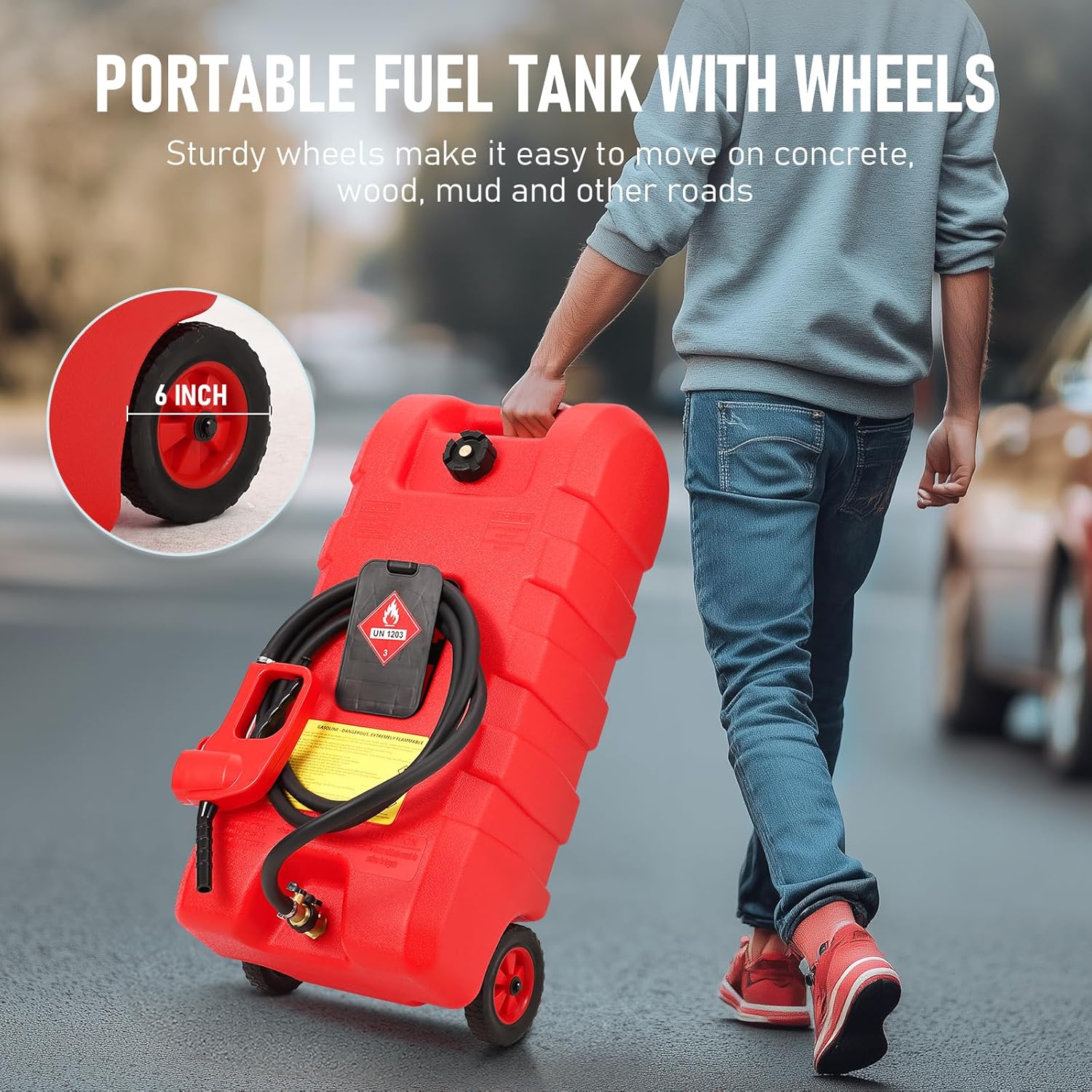
A wheeled fuel caddy is exactly what it sounds like: a portable tank — usually made of high-density polyethylene (HDPE) plastic — mounted on a rolling cart frame so you can move 15 to 45 gallons of gasoline, diesel, or mixed fuel without lifting it. The “caddy” part matters because these aren’t the small red plastic jerry cans you carry by hand; they’re genuinely heavy when full (a 25-gallon gasoline caddy weighs around 160 pounds loaded), and the wheels are doing serious structural work. If you’ve been managing fuel with a collection of 5-gallon cans and you’re tired of the trips, the splashing, and the math, a wheeled caddy is the natural next step. This guide will help you decide what size actually fits your operation, whether a hand-pump or a 12V electric pump is the right call for your workflow, and where the cheap options quietly fail you over the first two seasons.
Sizing Reality: Why “More Tank” Isn’t Always the Answer
The 15–45 gallon range covers a lot of ground, and the right size isn’t the biggest one you can afford — it’s the one that matches your actual throughput cycle.
15–20 gallon caddies are the entry point. They’re genuinely portable in a way a 30-gallon unit isn’t — most weigh under 90 pounds empty and fit in a truck bed without a ramp. Generator backup operators, weekend overlanders, and homeowners fueling a riding mower and a generator will find this range sufficient. The limitation is that at current mid-2026 pricing, HDPE tanks in this range from brands like Moeller and Attwood tend to share the same pump mount fittings as the larger units, so you’re not giving anything up on the accessory side.
25–30 gallon caddies are the workhorse tier. This is where most serious overlanding builds, small farm operators, and marine dock setups land. A 30-gallon tank carries enough fuel to top off a full auxiliary tank system or refuel multiple small engines in a single session without replenishment. The tradeoff: these units are not truly portable once loaded. A 30-gallon diesel caddy runs roughly 220–230 pounds full. You need a stable surface, a ramp if you’re loading into a truck bed, and a tie-down plan if you’re transporting it.
35–45 gallon caddies are a commitment. At this size, you’re operating something closer to a semi-permanent fuel point than a portable caddy. Rural property managers who position one of these units seasonally near a diesel tractor or generator bank make good use of them — but if you’re moving this size regularly, you’ve probably already started pricing out a proper transfer tank with a bed-mount kit.
By the Numbers
| Tank Size | Loaded Weight (Gasoline) | Loaded Weight (Diesel) | Recommended Pump |
|---|---|---|---|
| 15 gal | ~100 lbs | ~110 lbs | Hand pump or low-flow 12V |
| 25 gal | ~165 lbs | ~180 lbs | 8–12 GPM 12V electric |
| 30 gal | ~200 lbs | ~220 lbs | 12–15 GPM 12V electric |
| 45 gal | ~305 lbs | ~330 lbs | 15 GPM+ 12V with auto-nozzle |
Weights are approximate, based on published fuel density figures from the U.S. Energy Information Administration and standard HDPE caddy frame specs.
Hand Pump vs. Electric: The Decision Frame Most Buyers Skip
The pump question is where most buyers anchor on price and end up second-guessing their decision within a year. Let’s name the tradeoffs directly.
Hand-Pump Rotary (Included with Most Entry Units)
Most caddies in the $150–$300 range ship with a rotary hand pump — the kind where you crank a handle in circles to move fuel. These are fine for low-volume, infrequent use. Published throughput on the common barrel-style rotary pumps included with caddies from brands like FloTool and No-Spill typically runs 10–15 gallons per minute if you’re cranking hard and continuously, though real-world operator reports put the practical figure closer to 5–8 GPM with a standard rhythm. Over a 25-gallon fill, that’s 3–5 minutes of continuous hand cranking.
That’s fine once a month. It’s not fine if you’re fueling a diesel tractor, a generator, and a side-by-side on the same morning, or if the person doing the fueling has any wrist or grip limitations. OSHA’s flammable liquids standard (29 CFR 1910.106) doesn’t speak to pump ergonomics directly, but the fatigue factor is real in commercial contexts.
The other failure mode for hand pumps is seal degradation. The internal rubber seals in inexpensive rotary pumps are rarely rated for E15 or ethanol-blended fuels beyond E10. If you’re running E10 consistently, verify the seal material — owners in long-run aggregated reviews consistently report premature seal failure in 12–18 months on lower-cost pumps when fuel blends aren’t matched to the seal spec.
12V Electric Pump: Where It Pays Off
The case for stepping up to an electric pump is almost purely a volume-and-frequency argument. If you’re moving 25+ gallons more than two or three times a month, the math on pump quality changes quickly.
Fill-Rite’s FR1210G — a 12V DC transfer pump that has become something of a benchmark in the portable fuel caddy segment — is manufacturer-rated at 15 GPM at peak flow with a 3/4-inch outlet. At that rate, a full 30-gallon caddy empties in about two minutes. The published spec sheet from Tuthill Corporation (Fill-Rite’s parent) lists the FR1210G as compatible with gasoline, diesel, and kerosene, with a manual nozzle and a 12-foot hose in the standard kit. For context, operators who run diesel-powered equipment on rural properties consistently rate this unit as the clearest single-item upgrade over stock caddy pumps.
The cost delta is real: a bare FR1210G pump kit runs $180–$220 depending on vendor at mid-2026 pricing, versus zero for the hand pump that ships with a $200 entry-level caddy. But if you’re already spending $250–$350 on a quality HDPE caddy, the total system cost at the mid-tier lands around $450–$550 — still well below the $600+ territory of a NATO-spec steel jerry can array with dedicated pump hardware.
The decision rule: If you’re fueling more than 50 gallons per month across all equipment, or if a single fueling session regularly exceeds 20 gallons, budget for the electric pump from the start. If you’re doing one light refuel per week, the included hand pump will outlive your patience for cranking before it mechanically fails.
Material and Certification: What the Stamp on the Tank Actually Tells You
This is the section that separates a $189 caddy from a $380 one, and the difference is mostly invisible until it isn’t.
HDPE (high-density polyethylene) is the universal material for portable fuel caddy tanks, and not all HDPE is equal. The relevant certification to look for is UN/DOT approval — specifically the UN marking that indicates the tank has passed drop, stack, and hydrostatic pressure testing under UN Recommendations on the Transport of Dangerous Goods. NFPA 30, the Flammable and Combustible Liquids Code from the National Fire Protection Association, references container standards that align with these UN certifications for portable liquid storage.
What this means practically: an un-certified caddy tank may be visually identical to a certified one but built to a lower wall thickness, with less UV stabilizer in the resin, and without the permeation resistance testing that matters for long-term fuel storage. Over one to two seasons of outdoor UV exposure and thermal cycling, lower-grade HDPE shows stress crazing around the outlet fitting — exactly where you don’t want it.
Moeller Marine’s fuel cell product documentation explicitly calls out USCG (United States Coast Guard) and EPA vapor emissions compliance in their marine-grade tanks. For non-marine caddies, look for the UN mark and a statement of HDPE resin specification from the manufacturer. Brands that don’t publish this information are almost certainly building to the lower spec.
The EPA SPCC (Spill Prevention, Control, and Countermeasure) rule — per the EPA’s official overview documentation — applies to facilities storing more than 1,320 gallons in aggregate, so most individual caddy operators aren’t in scope. But the design philosophy behind SPCC-compliant containment (sealed fittings, no gravity-drain outlets without manual shutoffs, bunded storage) is a useful mental model for evaluating any caddy’s fitting quality.
Fitting Compatibility: The Detail That Bites You at the Worst Time
If you already own pump equipment — say a Fill-Rite or GPI electric pump with a standard 3/4-inch NPT outlet — verify the caddy tank’s inlet/outlet thread spec before buying. NPT (National Pipe Tapered) is the North American standard; BSPP (British Standard Parallel Pipe) threads are common on European-origin hardware. They are not interchangeable. A 3/4-inch NPT pump won’t seal on a 3/4-inch BSPP tank bung without an adapter, and discovering this after the caddy is full is not fun.
Most domestic HDPE caddies use 2-inch NPT tank bungs at the fill port and a separate 3/4-inch NPT pump outlet port. If you’re integrating a third-party pump, confirm the outlet port thread spec in the product documentation before purchasing. Brands like Roughneck and FloTool publish this in their tank specs; some do not, which is its own signal.
Hose diameter matters for electric pump performance more than most buyers realize. A 12V pump rated for 15 GPM will not achieve that flow through a 1/2-inch hose — the friction loss drops it significantly. The Fill-Rite FR1210G is designed around a 3/4-inch hose; using the included hose (rather than substituting a smaller-diameter aftermarket hose to save money) is how you actually get the advertised flow rate.
The Honest Upgrade Path
Here’s where to draw the line between “buy once, run for five years” and “buy cheap, replace in two”:
Under $250 total budget: An entry-level 15-gallon HDPE caddy with the included rotary pump is appropriate. Don’t over-invest. Keep it for light residential use, store it out of direct UV when not in use, and plan to replace the pump seals or the pump itself after 2–3 seasons.
$350–$500 budget: Step up to a 25-gallon UN-certified HDPE caddy and invest the remaining budget in a quality electric pump rather than a larger tank. Volume and speed matter more than total capacity for most operators in this range.
$500+ budget: At this level, a 30-gallon UN-certified caddy with a Fill-Rite FR1210G or equivalent 12–15 GPM pump is the honest recommendation. You’re building a durable fuel transfer system, not a disposable appliance. Operators in aggregated long-run reviews consistently report 5–8 year service life from this tier of equipment when maintained properly — hose inspections annually, pump filter cleaned seasonally, tank stored with a fuel stabilizer dose (STA-BIL 360 at the label-specified rate for your storage window) if fuel will sit more than 60 days.
If you’re at 45 gallons and moving fuel professionally or commercially, the conversation shifts toward a bed-mount transfer tank with a permanently wired pump circuit — the wheeled caddy format has physically outgrown its optimal use case at that point.
The decision isn’t complicated once you know your actual volume. Most buyers who regret their caddy purchase either bought too small and hit the capacity ceiling immediately, or bought a larger tank but paired it with a hand pump that couldn’t keep up with their workflow. Match the pump to the volume first, then pick the tank size that holds a realistic session’s worth of fuel without requiring daily replenishment.