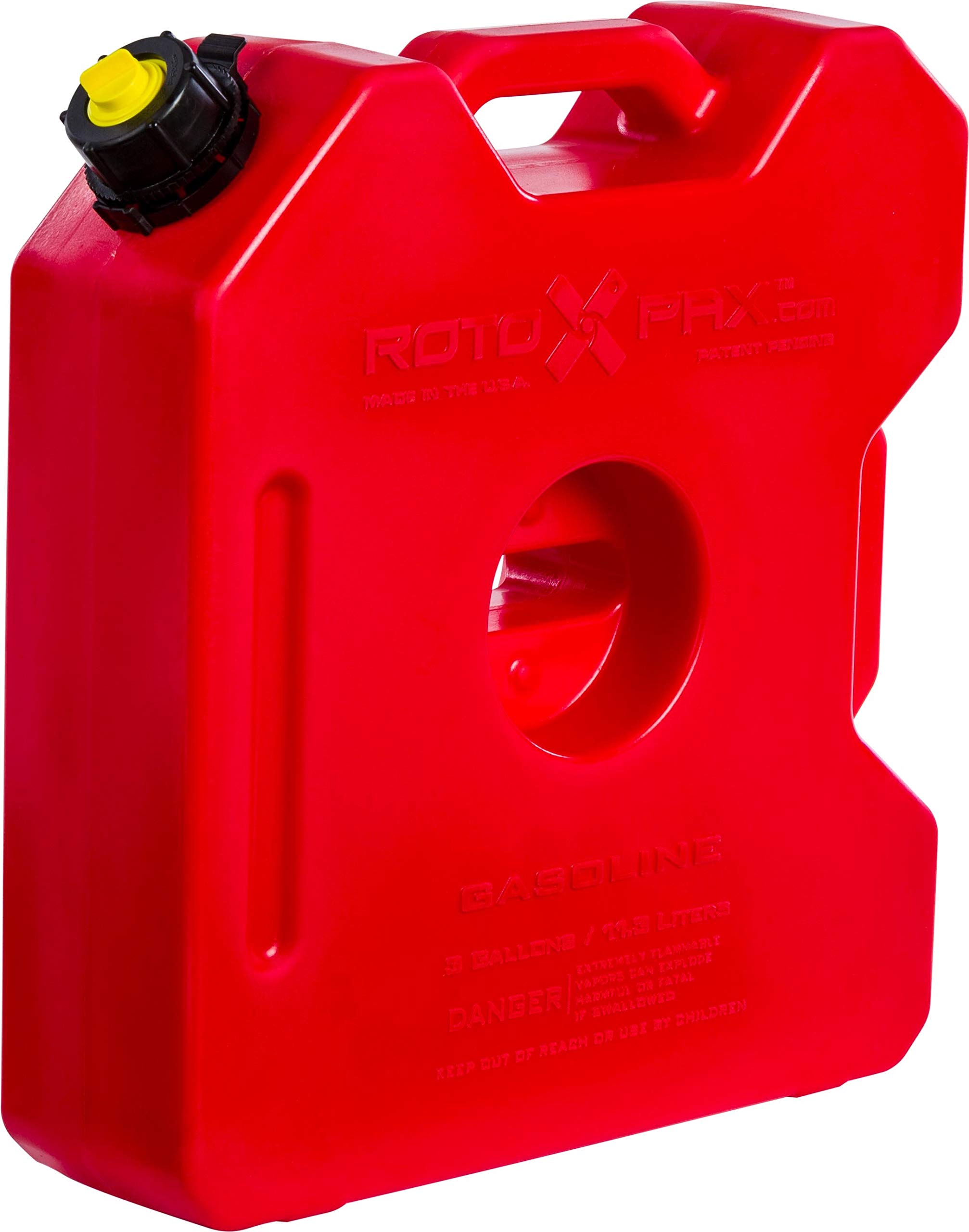
RotopaX fuel packs are modular, hard-plastic containers designed to mount flat against the exterior of a vehicle — a truck tailgate, a roof rack panel, a spare-tire carrier, or a rear door — rather than sitting loose in a truck bed or cargo area. Think of them as fuel bricks: low-profile, stackable, and specifically shaped to bolt through a steel plate called a mount pack (the hardware that anchors the whole assembly to your vehicle). If you’ve been carrying a standard 5-gallon NATO-style jerry can bungeed to your roof rack and wanted something lower, more aerodynamic, and better integrated with your build, RotopaX is the system most overlanders are evaluating. This guide covers how the mounting hardware actually works, how to think through the capacity math for real-world range extension, where the system fits well and where it genuinely doesn’t, and the decision rules that separate a clean build from an expensive compromise.
How the RotopaX Mounting System Works — and Where It Gets Complicated
The core of any RotopaX installation is the mount pack, a flat steel bracket with a central locking knob that threads through a hole in the mount and into the back of the fuel pack itself. The fuel pack spins onto the knob, clicks into a locked position, and can be released with the knob’s integrated quarter-turn mechanism. RotopaX offers several mount variants — the standard flat plate, the MOLLE-compatible plate, the bed-rail and tube-clamp options, and the integrated spare-tire carrier mounts — each targeting a different attachment surface on the vehicle.
What owners and builders consistently flag in long-form build threads and aggregated reviews is that the mount-to-surface interface is the real variable, not the pack-to-mount interface (which is standardized across the lineup). Bolting a mount plate to a flat aluminum roof rack cross-member with four M6 bolts through pre-drilled holes is straightforward. Bolting to a curved rear door skin, a tubular swing-out bumper, or a third-party spare-tire carrier introduces fitment work that RotopaX’s out-of-box hardware only partially solves.
Per RotopaX’s published installation documentation, the flat mount pack requires a minimum panel thickness of 3mm and a bolt pattern of approximately 2.5 inches on center. That matches most aftermarket steel bumpers and rack components, but not factory sheetmetal doors without additional backing plates to distribute load. Popular Mechanics’ 2025 overlanding build guide notes this as a consistent friction point: RotopaX installations on factory rear doors require a steel backing plate on the interior panel to prevent pull-through under trail vibration, and that step isn’t always called out clearly in entry-level build content.
The locking knob system is rated by RotopaX for security against casual theft and trail-vibration loosening, but builders running long-distance washboard roads in aggregated overland community reviews note that secondary retention — a stainless safety cable looped through the knob and anchored to the mount plate — is worth adding on packs mounted to high-vibration surfaces like tube bumpers or roof racks without rubber-damped cross-members.
Capacity Options and the Real-World Range Math
RotopaX packs ship in 1-gallon, 1.5-gallon, 2-gallon, 3-gallon, and 4-gallon capacities (gasoline and diesel variants; water and dry-storage packs use the same form factor). The 2-gallon is the volume sweet spot in most build discussions — compact enough to fit two stacked on a standard spare-tire carrier without exceeding the carrier’s rated load, large enough to matter as emergency reserve fuel.
By the numbers:
| Pack Size | Approx. Weight (full, gasoline) | Range Added (20 MPG vehicle) | Stacked Pair Weight |
|---|---|---|---|
| 1-gallon | ~7 lbs | ~20 miles | ~14 lbs |
| 2-gallon | ~14 lbs | ~40 miles | ~28 lbs |
| 3-gallon | ~21 lbs | ~60 miles | ~42 lbs |
| 4-gallon | ~28 lbs | ~80 miles | ~56 lbs |
(Weights based on gasoline at approximately 6.1 lbs/gallon plus published empty pack weights from RotopaX spec sheets. Range figures assume 20 MPG; adjust for your platform.)
The decision here isn’t just about maximum range — it’s about what your mount location can structurally support. A factory spare-tire carrier on a mid-size truck is typically rated for a single full-size spare (roughly 45–55 lbs for a 16–17-inch wheel and tire assembly). Adding two full 3-gallon packs (42 lbs) to that same carrier approaches or exceeds the carrier’s design load, especially on vehicles where the spare mounts to the rear door rather than a dedicated frame-mounted swing-out.
Aftermarket swing-out bumpers from manufacturers like ARB, Warn, and Smittybilt are typically rated for 100–150 lbs combined load across the spare and accessory positions, which comfortably accommodates a pair of 2-gallon or even 3-gallon packs. If your build already includes an aftermarket swing-out, the 2x2-gallon or 2x3-gallon configuration is the practical sweet spot for most mid-size and full-size truck platforms before weight management becomes a priority concern.
For vehicles with roof rack space rather than rear swing-outs, the aerodynamic and center-of-gravity implications shift the math. Outside Online’s 2025 overland gear guide specifically notes that fuel carried high and far aft has measurable effects on handling dynamics on technical terrain — the 1-gallon and 1.5-gallon packs mounted to a roof rack are better treated as true emergency reserve (get-home capacity) rather than primary range extension.
HDPE vs. Metal Containers: Where RotopaX Fits in the Certification Landscape
This is the comparison that matters most for the practitioner audience, because it’s where building enthusiasm sometimes outpaces honest evaluation.
RotopaX fuel packs are manufactured from high-density polyethylene (HDPE), the same base material as most EPA-compliant portable fuel containers. Per RotopaX’s published documentation, their packs carry DOT and UN/DOT certifications for transport of flammable liquids, which satisfies federal requirements for over-the-road transport of gasoline and diesel in the volumes these packs cover.
What HDPE RotopaX packs are not is a direct substitute for UN-certified steel containers like Wavian or NATO-spec Scepter MFC cans in high-risk fire environments. NFPA 30, the flammable and combustible liquids code, distinguishes between approved metal safety containers and portable containers for transport — the regulatory framework treats them differently. For overland use where the primary risk is trail-side vehicle fire or a collision scenario, steel containers are more resistant to rupture and do not melt in a ground-level fire the way HDPE will under sustained flame exposure.
The honest framing, per aggregated operator reviews and the published UN transport of dangerous goods guidance: RotopaX packs are excellent auxiliary trail reserve containers on a vehicle that is moving, stored in a location away from exhaust and heat sources, and not being used as a primary fuel storage solution at a fixed site. For fixed-site storage — a cabin generator, a farm fuel depot, a marine dock — UN-certified metal containers or OSHA-compliant safety cans remain the correct tool.
The EPA’s 40 CFR Part 59 Subpart F portable fuel container regulations, updated in 2022, also require automatic pressure-relief and automatic closure on containers sold after the compliance date. RotopaX’s newer pack generations incorporate a pressure-relief vent in the cap assembly to meet this requirement. If you’re looking at older RotopaX inventory — identifiable by caps without the integrated vent feature — verify compliance before purchasing for post-2022 regulatory contexts.
Overland Build Integration: Fitment Sequences and Common Mistakes
Getting the integration right requires working backward from your access and use frequency requirements before committing to mount locations.
Packs mounted on a rear swing-out are the most accessible — you open the gate, the pack is at waist height, and fueling is a two-minute operation. Packs mounted to a roof rack require a step or ladder and add the complexity of pouring downward from height, which increases spill risk on uneven terrain. The 1.5-inch extended knob adapter RotopaX sells addresses one common complaint (limited clearance for hand clearance when stacked multiple packs deep) but adds another 1.5 inches of pack-to-surface standoff that can interfere with door clearance on some swing-out configurations.
Common build sequencing mistakes flagged consistently in overland community documentation and reviews:
-
Ordering packs before confirming mount plate fitment. The mount plate bolt pattern needs to match your rack or bumper’s pre-drilled positions, or you’re drilling into structural steel — which is doable but adds shop time and can void rack warranties.
-
Over-specifying capacity on the first build. Most practitioners who have run RotopaX systems long-term report that a single 2-gallon pack for true emergencies covers the actual need on routes with reasonable fuel stop spacing. The appeal of four stacked packs is real, but the practical fueling frequency rarely justifies the weight penalty on street-legal daily drivers.
-
Ignoring vapor management. HDPE containers breathe slightly more than sealed steel, and in high-heat environments (dark paint, direct sun, desert temperatures), the pressure-relief vent will cycle. This is normal and EPA-intended, but mounting a pack directly behind a hot exhaust-proximate panel accelerates this cycling and increases vapor loss over a season. Mount locations with shade or airflow are meaningfully better for long-term fuel quality.
-
Skipping fuel stabilizer for stored capacity. A pack topped off at the trailhead and left mounted for 60–90 days between trips is a degraded-fuel scenario. Per STA-BIL’s published dosage guidance (1 oz per 2.5 gallons for storage beyond 30 days), a pair of 2-gallon RotopaX packs needs roughly 1.5 oz of stabilizer at fill-up if those packs aren’t being rotated actively. This is a small step that most build guides omit entirely.
The Decision Framework: If X, Then Y
Here’s the decision structure based on published specs, verified capacities, and what operators consistently report:
If your vehicle has an aftermarket swing-out bumper rated 100+ lbs: Run two 2-gallon packs on the swing-out arm in a stacked vertical configuration. This is the highest-accessibility, best-value configuration for 80% of overland builds. Add the extended knob adapter if your swing-out arm depth is under 3 inches.
If you’re mounting to a factory spare-tire carrier on a rear door: Stay at a single 2-gallon pack, maximum. Confirm your door hinge load rating before drilling. Add an interior steel backing plate.
If your primary build surface is a roof rack: Treat RotopaX packs as emergency-only reserve in 1-gallon or 1.5-gallon size. Do not use the roof as your primary range extension strategy — prioritize an in-bed auxiliary tank or a frame-mounted swing-out if extended range is a genuine requirement.
If your use case involves fixed-site or long-term storage rather than vehicle transport: RotopaX is the wrong tool. Move to a Wavian or Eagle UN-certified steel container for the storage application, and keep the RotopaX on the vehicle for trail reserve.
If you’re choosing between the 2-gallon and 3-gallon pack for a first installation: Start with the 2-gallon. The 3-gallon’s weight premium over a pair of 2-gallons is modest, but the 2-gallon form factor integrates more cleanly with the widest range of aftermarket mount surfaces. Upgrade to 3-gallon packs when you’ve confirmed your mount location handles the load without issue.
The RotopaX system earns its place in a well-built overland setup when it’s doing what it’s actually designed for: low-profile, certified, accessible trail reserve on a vehicle with proper mount infrastructure. The mistakes happen when builders treat it as an all-purpose fuel storage solution rather than one piece of a broader fuel management strategy.