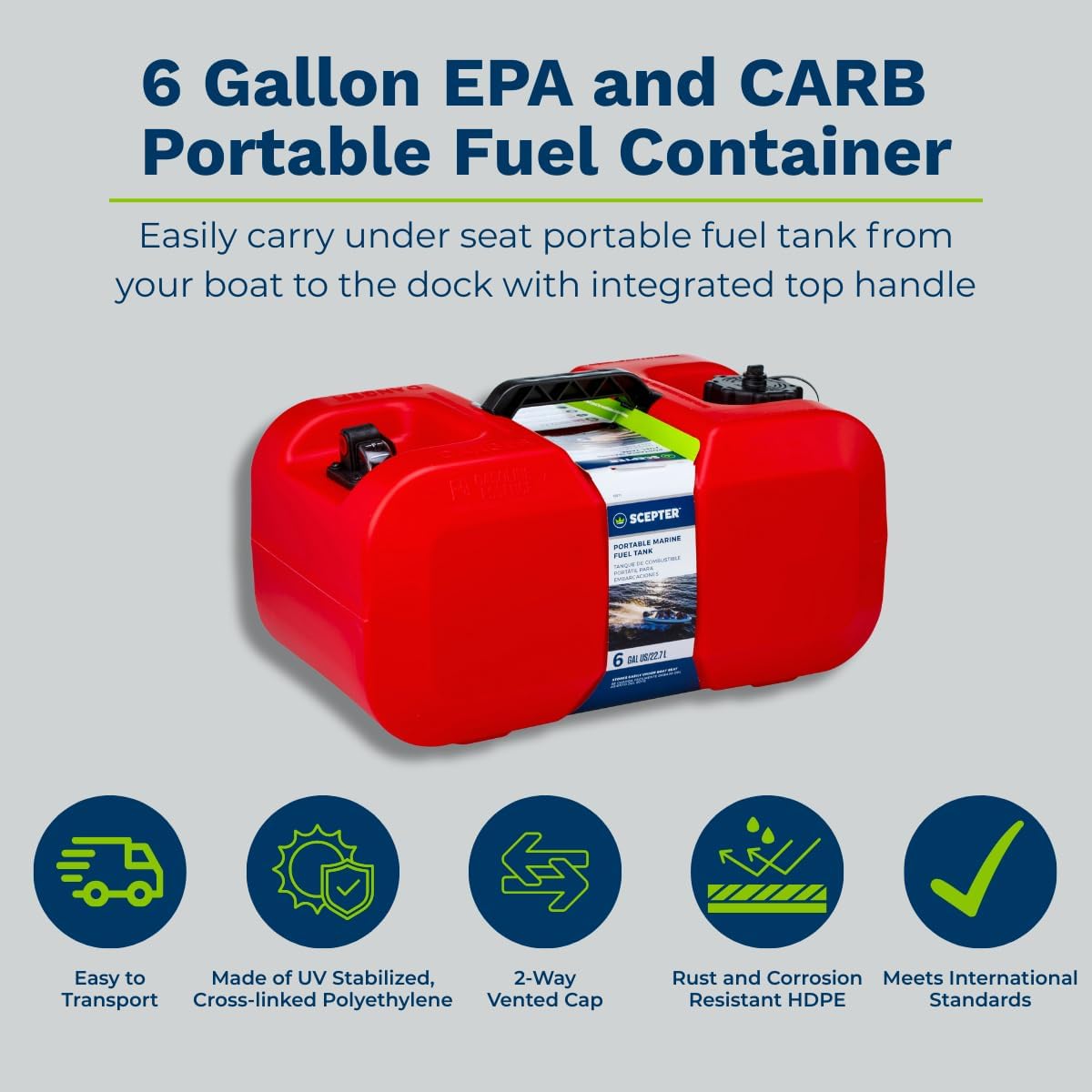
If you’ve ever reached under the seat of a center-console or bass boat and found a fuel tank with a vague smell and an unlabeled vent fitting, you already know the problem this article is about. A portable marine fuel tank is the self-contained plastic container — separate from any built-in hull tank — that feeds an outboard engine through a fuel line and primer bulb. These tanks range from 3 to 12 gallons and live in tight, poorly ventilated compartments. Because gasoline vapor is heavier than air and collects fast in enclosed spaces, the way these tanks are built and certified directly determines whether your bilge stays safe or becomes a hazard. This guide covers what the USCG (U.S. Coast Guard) and EPA certification stamps on a Scepter tank actually require the manufacturer to prove, how Scepter’s SmartControl vent system manages vapor differently from older designs, and how to match tank volume and footprint to the space you actually have. By the end, you’ll have a clear decision rule for choosing the right Scepter configuration for your application.
What USCG and EPA Certification Actually Requires
The two regulatory stamps you’ll see on a compliant portable marine fuel tank — USCG acceptance and EPA certification — are not the same thing and do not test for the same failure modes. Understanding both is the difference between buying a tank because it has the right logo and buying one because you know what it had to survive to earn it.
USCG requirements for portable fuel systems on recreational vessels are codified under 33 CFR Part 183, Subpart J. Per U.S. Coast Guard Navigation and Vessel Inspection Circular (NVIC) 7-95 on portable fuel systems, tanks must resist permeation of fuel vapor through the tank wall, must incorporate a vent that prevents liquid fuel from escaping under conditions of overfill or vessel motion, and must use materials that do not degrade from prolonged contact with marine-grade gasoline blends including ethanol blends up to E10. The construction standard also requires that the tank and all fittings withstand a drop test and a pressure test without cracking or leaking.
EPA 40 CFR Part 1060 — the regulation governing marine spark-ignition engines and vessels — takes a separate but complementary angle. Its primary concern is diurnal permeation: the slow migration of hydrocarbon molecules through tank walls during the daily temperature cycle of heating and cooling. Practical Sailor’s portable fuel tank review and permeation standards update (2023) notes that pre-2011 portable tanks were allowed permeation rates as high as 1.5 grams of hydrocarbon per gallon per day; post-2011 EPA-certified tanks must meet a tighter standard closer to 0.4 g/gal/day. That difference matters in a fiberglass cockpit or enclosed storage well — older tanks were effectively bleeding vapor continuously.
Scepter’s current portable marine line is manufactured to satisfy both regulatory frameworks simultaneously. According to Scepter Marine product documentation (2025), their tanks are constructed from high-density polyethylene (HDPE) with a multi-layer co-extrusion process that incorporates a barrier layer specifically engineered to meet post-2011 EPA permeation thresholds. They also carry the UL listing that satisfies USCG 33 CFR Part 183. That dual compliance is not a given across all brands at the mid-tier price point — when comparison shopping, confirm both stamps explicitly.
ABYC Standard H-24 (Gasoline Fuel Systems) is the third document worth knowing. While ABYC compliance is technically voluntary for boat builders, most marine insurers and surveyors treat H-24 as the de facto construction benchmark. H-24 requires, among other things, that portable tank fuel fittings be designed to prevent vapor lock under negative fuel head conditions and that vent systems incorporate a means to prevent overflow spill. Tanks sold by Scepter for the North American marine market are documented by Scepter as H-24 compatible, though you should verify the specific SKU against your insurer’s requirements if you’re outfitting a vessel that will undergo survey.
The SmartControl Spout and Vent System: What It Solves and Where It Adds Friction
The SmartControl system is Scepter’s answer to two problems that plagued earlier portable marine tank designs: spillage during fuel transfer and vapor escape during normal storage.
On older tanks, the vent was a simple manually-operated screw or push-button fitting. Operators frequently forgot to close it before trailering or storage, allowing vapor to migrate out freely. The fuel delivery fitting — typically a bayonet-style connector — had no integrated shutoff, which meant any fuel remaining in the line after the primer bulb could drip when disconnected. Boating Magazine’s portable marine fuel tank buyer’s guide (2024) cites vent-left-open scenarios as one of the top sources of unnecessary hydrocarbon odor and vapor accumulation in storage compartments.
The SmartControl design integrates the vent function into the fuel cap assembly rather than making it a separate fitting the operator has to remember. According to Scepter Marine product documentation, the vent is normally closed by default and opens automatically in response to internal pressure differential — specifically, the negative pressure created when the engine draws fuel through the line. This means:
- At rest, the vent is closed. Vapor accumulation during trailer transport or marina storage is minimized.
- Under engine load, the vent cracks open just enough to equalize pressure and prevent fuel starvation (the classic symptom of a clogged or closed vent: engine surging and dying at cruise RPM).
- The fuel delivery fitting includes a positive shutoff valve integrated into the tank-side female fitting, so disconnecting the fuel line doesn’t drain residual fuel from the line connector.
Where the SmartControl system adds friction: The integrated vent mechanism means you cannot simply open the vent manually to accelerate pressure equalization on a hot day. Operators who have run older Tempo or Attwood tanks — which use a simple finger-operated vent toggle — sometimes find the SmartControl vent slow to respond during warm-up on hot days when internal tank pressure is already elevated from thermal expansion. Practical Sailor’s permeation standards review notes that fully sealed vent designs occasionally cause fuel delivery lag during the first minute of engine operation if the tank has been sitting in direct sun. The practical workaround is straightforward: loosen the fuel cap a quarter turn before starting the engine, then re-tighten once fuel flow is established. It’s a minor ergonomic trade-off for a measurable gain in vapor containment.
The fuel delivery connector on the SmartControl system uses Scepter’s proprietary push-lock fitting, which is compatible with standard 3/8-inch EPA-compliant fuel line assemblies with the push-lock adapter. If you’re connecting to an older engine with a pre-EPA barbed fitting and a non-locking fuel line, you’ll need an adapter. Confirm your engine’s fuel line terminus before purchase — this is a $4 adapter problem, not a compatibility dead end, but it’s worth knowing upfront.
Under-Seat Sizing: Matching Volume and Footprint to Your Hull
This is where the decision gets spatial. Portable marine tank sizing is a dual-variable problem: you need enough fuel capacity for your range profile, and the tank has to physically fit the storage compartment without blocking bilge drainage or ventilation flow.
By the numbers:
| Scepter Tank Size | Approximate Footprint (L × W × H) | Weight Full (gasoline ~6.1 lb/gal) |
|---|---|---|
| 3 gallon | 14” × 9” × 9” | ~20 lb |
| 6 gallon | 18” × 13” × 9” | ~38 lb |
| 9 gallon | 22” × 13” × 11” | ~57 lb |
| 12 gallon | 22” × 15” × 13” | ~75 lb |
Dimensions are approximate from published Scepter Marine product specifications. Verify against your storage well dimensions before ordering.
The 6-gallon configuration is the most commonly specified for 14–17-foot aluminum fishing boats and single-engine inflatables running 25–60 hp outboards. It fits the standard under-seat well on most Jon boat bench seats and keeps full-load weight manageable for one-person handling at the ramp. At a conservative fuel burn of 1 gallon per hour at cruise RPM on a 40 hp four-stroke, a full 6-gallon tank gives you roughly 2.5–3 hours of operating range before you’re drawing on your reserve mental buffer.
The 9-gallon tank is the sweet spot for offshore center-consoles and walkarounds where the storage compartment has more depth but the operator wants to avoid carrying two tanks. Per ABYC H-24, two portable tanks are permitted in a single storage well provided combined capacity does not exceed the vessel’s portable fuel system design allowance — but managing two fuel lines and two primer bulbs at the helm adds procedural complexity that most operators don’t want offshore.
The 12-gallon tank should be evaluated carefully against your hull’s weight distribution. At 75 pounds full, it’s at the upper limit of single-person lifting ergonomics, and placing it aft-of-center in a small hull affects trim noticeably. Boating Magazine’s buyer’s guide recommends the 12-gallon configuration primarily for vessels with dedicated, secured tank compartments rather than loose under-seat stowage — not because the tank is structurally unsuitable, but because a 75-pound unsecured object in a rough-water scenario creates a genuine hazard.
Decision Rules: Which Configuration Fits Your Situation
If your application is a small aluminum or fiberglass fishing boat, single outboard, day-use range within 15 miles of the ramp: the 6-gallon Scepter with SmartControl is the straightforward answer. It hits the compliance checkboxes, fits standard under-seat dimensions, and keeps handling weight reasonable.
If you’re running a center-console in offshore conditions where range and fuel reserve matter more than portability: the 9-gallon is the better fit, provided your storage well accommodates the footprint. Measure the well first — specifically the internal height, because the 9-gallon sits meaningfully taller than the 6-gallon and clearance to a fiberglass lid can be tighter than the external dimensions suggest.
If you’re comparing Scepter against Attwood or Moeller at the same tier: the differentiation is primarily in the vent system and fitting compatibility. Scepter’s SmartControl vent is the most vapor-sealed passive system in the portable marine category as of mid-2026, per aggregated operator reviews and Practical Sailor’s comparative coverage. Attwood’s tanks use a comparable multi-layer wall construction for EPA permeation compliance, but their vent is manually operated — better for operators who want direct control, marginally less effective for passive vapor management during storage. Moeller’s marine tanks carry the same USCG and EPA stamps and are favored by operators who prioritize fitting universality, since Moeller uses a more widely compatible connector standard. Neither Attwood nor Moeller is a wrong answer; the SmartControl vent is the specific reason to choose Scepter if vapor management in an enclosed compartment is your primary concern.
If you’re outfitting a vessel that will undergo formal survey for insurance or documented-vessel status: pull the H-24 standard from the ABYC directly and verify the specific Scepter SKU against it. The compliance picture is clean for current-production Scepter tanks, but surveyors check SKU-level documentation, not brand reputation.
The certification stamps matter. The vent design matters. The footprint matters in that order — and Scepter’s current portable marine line earns a serious look at each step of that checklist.