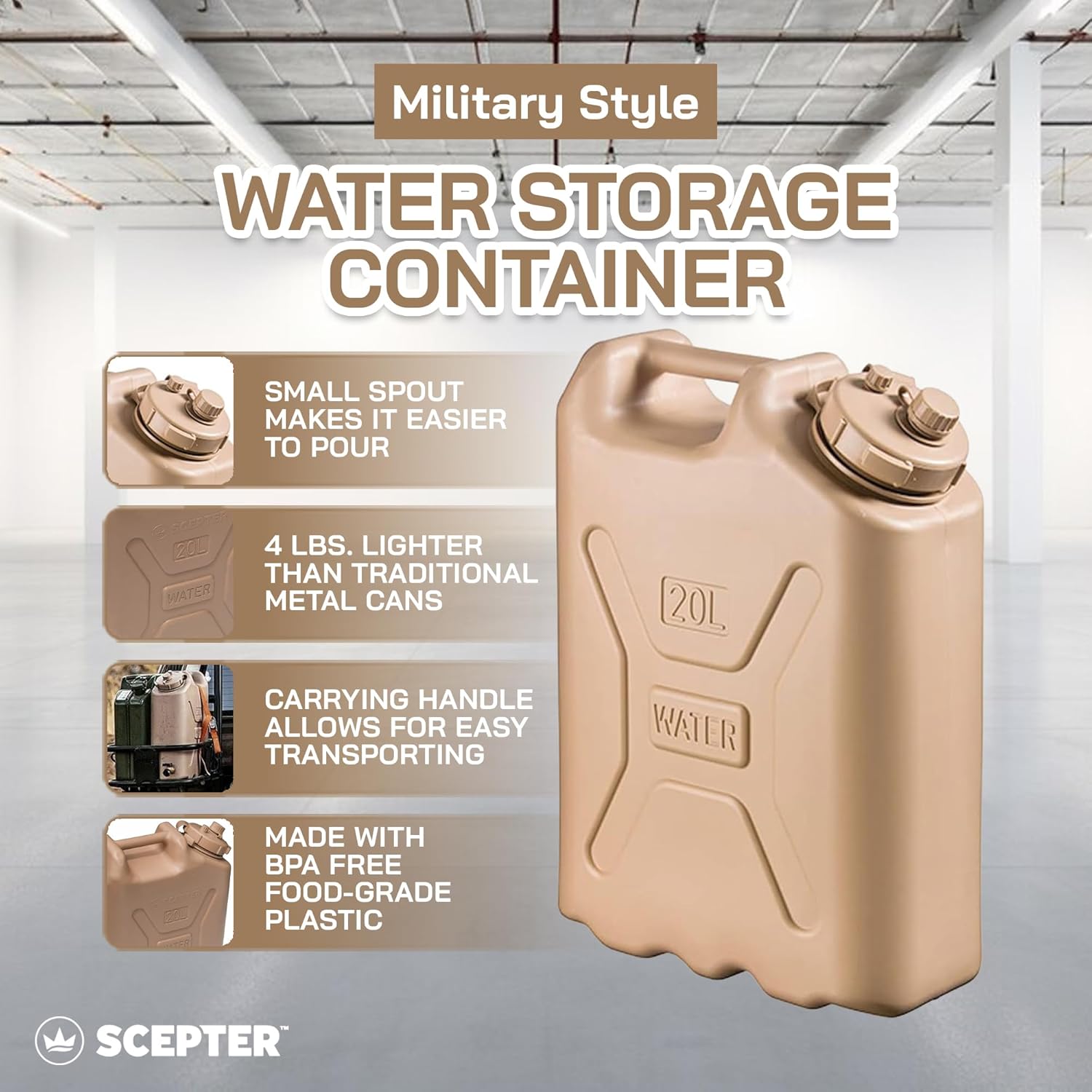
If you’ve ever watched a 5-gallon water jug roll around your truck bed on a washboard road, you already understand the core problem that military water containers were designed to solve. A military-style water container — sometimes called an MWC or “water jerry can” — is a rigid, rectangular, stackable vessel built to the same NATO-derived dimensional standards as fuel jerry cans, but manufactured from food-grade plastic (specifically high-density polyethylene, or HDPE, a plastic that won’t leach harmful chemicals into drinking water) rather than the steel used in fuel storage. The result is a container that fits the same can holders, roof-rack mounts, and cargo tie-down setups you probably already have. Scepter, the Canadian manufacturer best known for its MFC military fuel containers, produces one of the most widely referenced versions of this design. This article walks through what makes those containers worth evaluating, where the tradeoffs live, and how to build an overlanding or remote-property water system around them without overbuying.
Why Scepter’s MWC Deserves a Serious Look
Scepter’s military water container — the 20-liter (roughly 5.3-gallon) MWC — is the water-side sibling of its MFC fuel container, and the relationship is more than cosmetic. Both share the same external footprint, which means a rack or cargo drawer dimensioned for Scepter fuel cans will accept the water cans in the same positions. That dimensional interchangeability is a genuine logistical advantage for overlanders running mixed fuel-and-water setups.
The material spec matters here. Scepter’s MWC is manufactured from food-grade HDPE and is rated to NSF/ANSI Standard 61, the standard established by NSF International that governs materials in contact with drinking water. Per the NSF Standard 61 documentation, this certification confirms that the plastic compound doesn’t leach contaminants at levels that pose health risks during normal storage. That’s a different standard than what a fuel can meets — fuel cans are built for UN/DOT pressure and permeation resistance, not food-contact safety. The distinction matters if you’re tempted to reuse old fuel containers for water: cross-contamination risk is real and hard to fully remediate, per Popular Mechanics’ 2024 emergency preparedness feature on long-term water storage.
The MWC also ships with Scepter’s reversible spout assembly, which is worth unpacking specifically. The spout can be oriented in two positions — a pour mode (spout extended outward for direct dispensing) and a stowed mode (spout folded inward, sealed by a cap) — that let the container be tightly capped for transport without a loose accessory to track. Owners on overlanding forums consistently note that the two-position design eliminates the “where did I put the spout cap” problem that plagues older NATO-style water cans with separate closure pieces.
The Spec Comparison That Actually Matters
Before buying multiples of any container, it helps to hold the key numbers side-by-side. Here’s a snapshot based on published manufacturer specifications and aggregated owner reports:
By the numbers — Scepter MWC 20L vs. comparable alternatives:
| Spec | Scepter MWC 20L | Generic NATO-copy HDPE | Reliance Aqua-Tainer 7G |
|---|---|---|---|
| Capacity | 20 L / 5.3 gal | 20 L / 5.3 gal | 7 gal / 26.5 L |
| Material | Food-grade HDPE (NSF 61) | HDPE (cert. varies) | HDPE (BPA-free, not NSF 61 rated) |
| NATO footprint match | Yes | Yes (mostly) | No |
| Reversible/integrated spout | Yes | Rarely | Spigot separate |
| Empty weight | ~2.5 lbs | ~2.0–2.8 lbs | ~1.5 lbs |
| Full weight | ~46 lbs | ~46 lbs | ~59 lbs |
The Reliance Aqua-Tainer comparison is useful because it’s the container most recreational campers encounter first. It’s cheaper and holds more volume, but it doesn’t stack the same way, doesn’t fit standard jerry can holders, and isn’t rated to NSF 61 at the time of this writing. Outside Online’s 2025 overlanding gear guide identifies the NATO-footprint stackability as the primary functional gap between consumer-market water jugs and military-spec containers for vehicle-mounted systems.
Reversible Spout Mechanics and Compatibility Gaps
The spout system is where Scepter’s MWC diverges most meaningfully from its fuel-can lineage, and where you need to think before buying accessories. The MWC spout is designed for gravity-fed dispensing — you tilt the can, liquid flows. It is not designed to accept the same type of aftermarket pump-and-hose fittings that fuel cans do.
This matters for a specific use case: water dispensing at a campsite or remote property where you want hands-free flow into a camp sink, stock tank, or pressurized camp-shower bladder. The MWC’s integrated spout threads are proprietary to Scepter’s design, meaning standard NPT (National Pipe Thread) fittings — the thread standard used on most American plumbing and many pump inlet fittings — won’t mate directly. Per Scepter’s published MWC specification sheet, the opening accepts Scepter’s own vent-and-pour spout assembly. Third-party adapters from brands like Wavian are designed for fuel containers and should not be assumed compatible without confirming the thread spec.
The practical workaround most overlanders use is a dedicated manual siphon or a 12V transfer pump with a universal inlet tube, rather than a can-to-fitting plumbing connection. For water-dispensing volume at remote properties, a Fill-Rite or similar 12V pump with a suction tube dropped into the open container is more reliable than attempting to thread-adapt the spout. That said, for straightforward campsite dispensing — filling a pot, a hydration reservoir, or a portable shower bag — the reversible pour spout handles the job without any accessories, which is exactly what it was designed for.
One interoperability note: the MWC cap and spout are not interchangeable with Scepter’s MFC fuel containers, even though the external dimensions match. The openings are different diameters by design, which prevents accidental cross-use. That’s a safety feature, not a flaw.
Building a Practical Overlanding Water System
The decision framework for how many MWCs to carry, and how to integrate them, comes down to three variables: trip duration, party size, and access to resupply.
Basic consumption math: The U.S. Army’s field guidance — referenced in STANAG 4280 compatibility documentation for NATO containers — uses a planning figure of approximately 1 liter per person per hour for moderate activity in temperate conditions, scaling to 1 liter per person per 30 minutes in high heat or heavy exertion. For overlanding purposes, a more conservative planning baseline is 4–6 liters per person per day for drinking and cooking, plus an additional 4–6 liters per person per day for camp hygiene if you’re not conserving.
For a solo overlander on a 3-day trip with no resupply:
- Drinking + cooking: 5 L/day × 3 days = 15 L
- Hygiene: 4 L/day × 3 days = 12 L
- Total: ~27 L, which is slightly more than one full 20L MWC
Two containers — 40 liters — provides a meaningful buffer for cooking spills, vehicle cooling needs, and the general inefficiency of field water management. For two people on the same trip, three containers (60 L) is a reasonable starting point with some margin.
The stacking argument for Scepter’s design becomes most compelling at this scale. Three MWCs in a truck bed, secured with cam straps through the factory handle cutouts, occupy roughly the same footprint as a small cooler and weigh a combined ~138 lbs when full — manageable as cargo, but worth positioning low and forward in the load plan.
The NSF 61 certification as a buying filter: When evaluating competing HDPE water containers, treat NSF 61 certification as a minimum bar for anything used for drinking water storage beyond a few days. Aggregated owner reports across overlanding communities flag a consistent pattern: uncertified containers sometimes develop a plastic taste over multi-week storage, particularly in warm vehicles. Popular Mechanics’ 2024 water storage feature notes that certified containers are formulated specifically to minimize this effect.
If X, Then Y — Decision Rules
By this point you have enough context to match your situation to a configuration. Here’s the decision tree:
If you’re outfitting a solo vehicle for weekend trips (1–3 days): One Scepter MWC 20L handles the water load with margin. Buy one, learn the spout system, and add a second only when you find yourself rationing.
If you’re running a two-vehicle convoy or a trip longer than 4 days without resupply: Three MWCs is the practical floor. Confirm your roof rack or cargo drawer accepts the NATO footprint before ordering multiples — most ARB, Maxtrax, and Gobi rack systems accommodate the dimension, but verify with your specific rack manufacturer’s spec sheet.
If you’re evaluating the MWC for remote-property or generator-backup water storage (stationary use): The MWC’s stackability and NSF 61 rating make it a legitimate choice, but the 20L size means frequent trips compared to 55-gallon barrels. The real value here is in emergency portability — if the grid fails and you need to relocate water, MWCs move by hand in a way barrels don’t.
If you want to plumb the container into a pressurized water system: The MWC is the wrong tool. Switch to a dedicated water bladder (Aquatank, WaterPORT, or similar) with standardized hose barbs, and use the MWC only as a gravity-fill reservoir into the bladder.
If you’re price-sensitive and considering a generic NATO-footprint HDPE can: Verify NSF 61 certification independently before purchase. The certification documentation should be available from the manufacturer on request. No documentation, no certification — the label alone isn’t sufficient. Outside Online’s 2025 overlanding guide flags this as the most common point of confusion when buyers compare Scepter to cheaper no-name alternatives.
The Scepter MWC isn’t the only serious option in this category, but it earns its reputation on the strength of consistent manufacturing tolerances, documented NSF 61 certification, and a spout design that functions without a separate loose part to lose on the trail. For overlanders and property managers who already understand the jerry can system — and who’ve thought through the access and dispensing workflow — it’s a natural extension of existing equipment logic rather than a category leap.