A NATO jerry can is a specific type of portable metal fuel container — originally designed to military specification during World War II — built to survive rough handling, stack reliably, seal against vapor loss, and mount to a vehicle without rattling itself apart on a washboard road. “NATO-spec” means the can meets dimensional and materials standards — primarily NATO STANAG 3570, the standardization agreement covering petroleum jerricans — that allow interoperability across military supply chains. For overlanders — people who outfit vehicles for extended off-road travel, often far from fuel stations — these cans are the default choice because they outlast plastic alternatives by decades and pair cleanly with roof-rack and bumper-mount hardware. But the category is flooded with lookalike cans that borrow the styling without meeting the spec. If you’ve already decided a quality steel can is the right call and you’re trying to figure out whether Wavian is worth the price premium and how to verify you’re getting the real thing, this article gives you the comparison framework and the decision rules.
Why Wavian Specifically, and Why Counterfeits Are a Real Problem
Wavian is a Finnish manufacturer that supplies NATO-alliance militaries. Their civilian cans — sold in the U.S. through Wavian USA — are built on the same tooling and to the same dimensional tolerances as their military production. That distinction separates them from the broader field of “NATO-style” cans that borrow the three-handle geometry without the weld quality, the steel gauge, or the UN/DOT certification.
Outside Online’s 2024 overlanding fuel storage gear feature noted that the field of NATO-style steel cans splits into two clearly distinguishable groups: verified-origin cans with traceable manufacturing provenance, and everything else. Wavian and Scepter MFC — a Canadian manufacturer with comparable military contracts — are consistently identified as the two genuine-production options available to U.S. civilians. Cans from other brands may look identical in a product photo, but Popular Mechanics’ 2025 jerry can editorial coverage observed that weld consistency and seam quality are essentially impossible to evaluate from a product listing, which is exactly where buyers get burned.
The counterfeit problem is not abstract. Operators across the overland community regularly report receiving cans with incomplete or shallow stamp markings, welds that show visible porosity or inconsistent bead width, and handles that flex noticeably under load. These are not cosmetic issues. A compromised weld on a fuel container strapped to a vehicle roof rack — subject to vibration, thermal cycling, and UV exposure — represents a genuine fire and vapor hazard. The EPA regulates portable fuel container emissions and seal integrity under its small engine evaporative emissions and fuel container standards program; a degraded or counterfeit closure gasket is not a compliant component regardless of what the product listing asserts. The NFPA, in NFPA 30: Flammable and Combustible Liquids Code, distinguishes between containers that meet recognized testing standards and those that do not.
Reading the Stamps: What Genuine Certification Looks Like
Every legitimate NATO-spec steel jerry can that’s legal for fuel transport in the U.S. market carries a UN certification mark. Understanding what that mark should look like is the most reliable way to separate genuine cans from knockoffs at the point of purchase.
The UN mark structure, per the United Nations Recommendations on the Transport of Dangerous Goods, Model Regulations, 23rd Revised Edition:
- The symbol
UN(or the graphic diamond equivalent) followed by the packaging code — for a steel jerrican, this is3A1(steel, non-removable head, liquids) - A slash followed by the maximum specific gravity rating (typically
1.2for petroleum products) - A second slash followed by the test pressure in kPa
- The year of manufacture (two digits)
- The country of origin code
- The manufacturer’s certification code
On a genuine Wavian 20L can, per the Wavian USA Product Specification Sheet for model WN0020G, this information is stamped — not printed, not applied as a sticker — into the steel on the body of the can near the base. The stamp should be crisp and deep enough to read by feel in low light. Shallow, faint, or partially legible stamps are a red flag.
The NATO stamp, when present, follows NATO STANAG 3570 formatting and includes a NATO stock number format with a country-of-origin prefix. Finnish-origin Wavian cans carry an FI country code. If a listing claims “genuine NATO” but shows a CN prefix or a blank country code field, that answers the provenance question definitively.
Reference specifications for a legitimate Wavian 20L can (per Wavian USA Product Specification Sheet, model WN0020G):
| Attribute | Spec |
|---|---|
| Steel gauge (body panels) | 0.9 mm cold-rolled |
| Capacity | 20L (5.3 U.S. gallons) |
| UN packaging code | 3A1 |
| Empty weight | ~3.5 kg (7.7 lbs) |
| Closure gasket material | Buna-N (nitrile), rated for gasoline and diesel |
| Closure type | Dry-break cam-lever with gasket |
The Wavian cam-lever closure — the flip-down handle mechanism that seats the spout fitting — is meaningfully tighter than what import alternatives typically provide. Gasket longevity is a genuine differentiator: Wavian’s Buna-N nitrile closure gasket is rated for both gasoline and diesel across a wide temperature range. Many import cans use a generic rubber compound that hardens and cracks after 18–24 months of thermal cycling. Popular Mechanics’ 2025 jerry can editorial coverage and Outside Online’s 2024 overlanding fuel storage gear feature both flag closure gasket degradation as the primary failure point on lower-cost alternatives.
Weld Quality: What to Inspect Before You Commit
Weld quality is where the genuine article separates from the field most visibly — and it’s something you can evaluate in person if buying locally, or after delivery if buying online.
What to look for on a Wavian or legitimate NATO-spec can:
- Continuous, consistent bead. The seam welds along the body panels should show uniform bead width with no gaps, skips, or burn-through pits. Running a fingernail along the weld should catch consistently — it should not skip over voids.
- Flush handle attachment points. The three-handle yoke is welded to reinforcement plates, not directly to thin body steel. On genuine cans, these attachment welds are ground smooth. On import alternatives, they are often raised or irregular.
- Bottom seam integrity. Turning the can upside down and inspecting the bottom seam under good light reveals the highest-stress weld point for a liquid-filled container under vibration. The Wavian USA Product Specification Sheet for model WN0020G lists this as a continuous resistance weld. Import alternatives frequently show spot-weld patterns here, which creates stress concentration points under sustained load.
- No surface rust at welds. Welding burns off zinc coating on treated steel. Legitimate manufacturers re-treat weld zones after fabrication. On import cans, bare metal at welds develops surface rust within months of first moisture exposure.
Outside Online’s 2024 overlanding fuel storage gear feature noted that operators running genuine Wavian cans on multi-year builds report zero weld failures, while the import can failure mode — when it occurs — is almost always a pinhole leak at a body seam under sustained vibration load.
Mount Compatibility: Matching the Can to Your Rack System
Mount compatibility is where many intermediate buyers get tripped up. The NATO jerry can footprint is standardized — NATO STANAG 3570, Jerricans for Petroleum Products, Edition 3 defines external dimensions — which means mounts designed for genuine-spec cans should fit any compliant container. In practice, dimensional tolerances on import cans vary enough that mounts engineered for Wavian geometry sometimes require shimming or fail to clamp cleanly.
Standard NATO 20L can external dimensions per NATO STANAG 3570:
- Height: approximately 450 mm
- Width: approximately 300 mm
- Depth: approximately 175 mm
Most aftermarket jerry can mounts from brands including ARB, Ironman 4x4, and purpose-built rack systems publish compatibility specs against these dimensions. If a mount lists “NATO standard” compatibility, it’s referencing these numbers. Wavian cans seat cleanly in compliant mounts without modification, a point confirmed in both Popular Mechanics’ 2025 editorial coverage and the Wavian USA Product Specification Sheet for model WN0020G.
Key mount fitment considerations:
- Strap vs. cradle design. Strap-style mounts are more tolerant of dimensional variation. Cradle mounts are tighter-tolerance. If you’re running a cradle mount, verify the manufacturer has tested against Wavian specifically, not just “NATO-spec” generically.
- Spout clearance. When the can is mounted, the spout-side face needs clearance for the cam-lever closure to operate. Many roof-rack orientations put the spout facing outward, but bumper-mount configurations can create clearance issues. Measure before committing to a mounting orientation.
- Dual-can spacing. Running two cans side-by-side — common on mid-length overland rigs — requires accounting for the handle yoke, which protrudes roughly 40 mm above the body plane. Rack systems must accommodate this when setting center-to-center spacing.
- Steel vs. plastic can mounts. Mounts designed for plastic modular containers use a completely different mounting boss geometry and are not interchangeable with NATO steel can mounts. Do not assume cross-compatibility.
Genuine vs. Import: Three Buyer Profiles Compared
At current U.S. market pricing, genuine Wavian 20L cans retail in the $65–$85 range per unit. Import “NATO-style” steel cans from unverified manufacturers run $25–$45. The cost delta is real and deserves a clear decision framework organized by how and where you’ll actually use the cans.
Budget Profile: Occasional Emergency Use on Mostly Paved Routes
If you’re running one or two cans as genuine emergency range extension on a vehicle that sees pavement 80 percent or more of the time, an import-origin can is defensible — with conditions. You should inspect welds carefully on receipt, replace the closure gasket immediately with a quality Buna-N aftermarket unit, and treat the purchase as a 3–5 year consumable rather than a permanent asset. The UN stamp may be present on these cans but must still be verified against the full mark structure described above. A partial or stickered UN mark does not satisfy DOT transport requirements regardless of what the listing claims. Per the U.S. Department of Transportation’s Hazardous Materials Regulations (49 CFR Part 178), the certification marking must be permanently applied to the container itself — a label or sticker does not qualify.
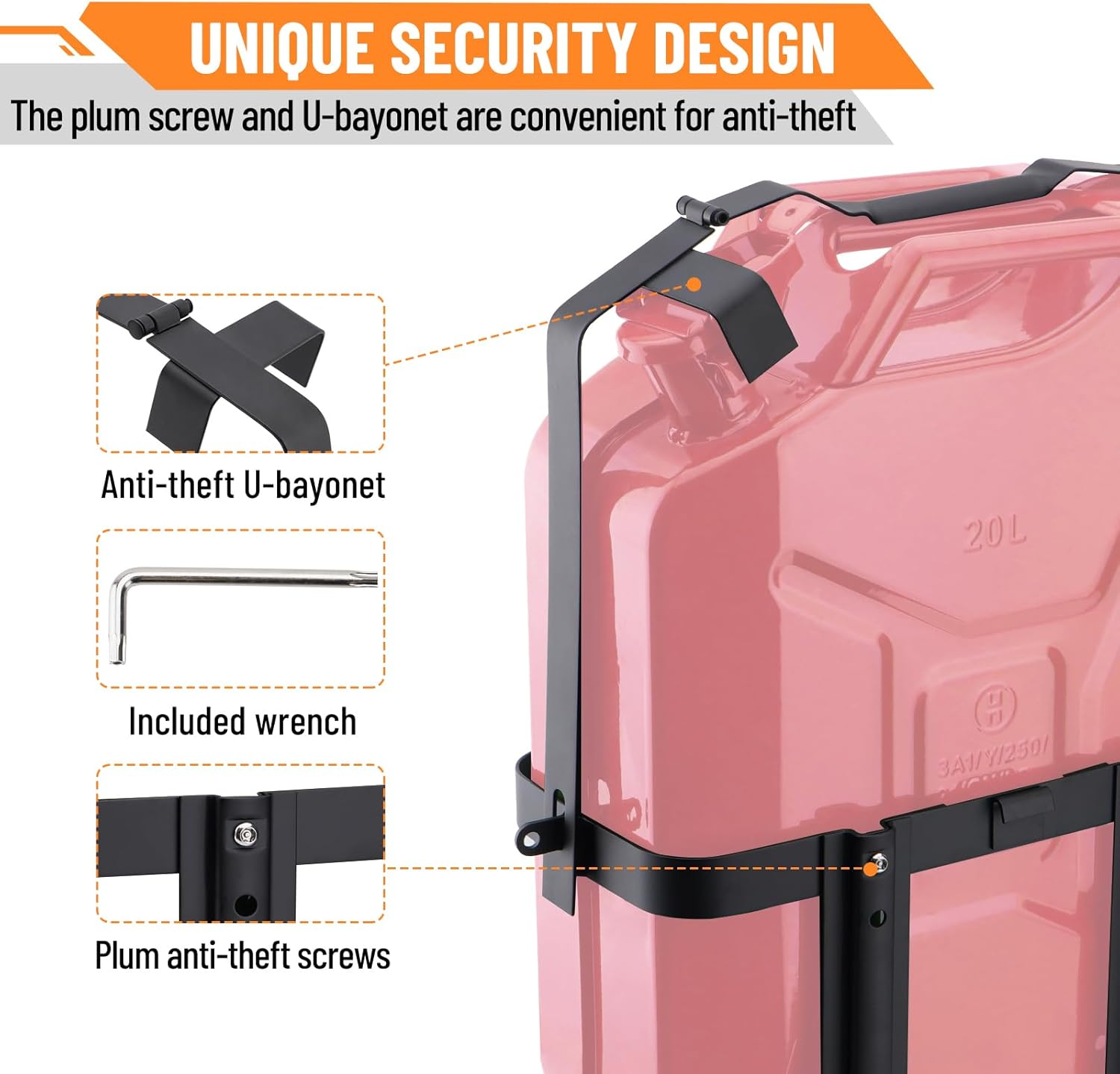
Anti-theft
$39.99
In stock on Amazon
Check price on AmazonMid-Tier Profile: Regular Off-Road Use with Rack or Bumper Mounting
If you’re mounting cans to a roof rack or swing-away bumper carrier on a vehicle that sees sustained off-road use, buy Wavian or Scepter MFC. Vibration load combined with thermal cycling is the precise failure mode that separates weld quality tiers, and a fuel leak at a seam weld on a loaded roof rack is not a theoretical risk — it is the documented import-can failure pattern identified in Outside Online’s 2024 overlanding fuel storage gear feature. At this use level, the cost-per-year math strongly favors the genuine article. Long-term operators report Wavian cans remaining serviceable past the 20-year mark; import alternatives show a consistent 3–7 year failure window in the same operator accounts. Popular Mechanics’ 2025 jerry can editorial coverage reached the same conclusion: for regularly mounted, road-vibration-exposed applications, genuine-origin cans are the only economically rational choice once the full replacement cycle is priced in.
RotopaX
$89.95
In stock on Amazon
Check price on AmazonPremium Profile: Dedicated Overland Build with Cans as Permanent Infrastructure
If you’re outfitting a dedicated overland build where the cans are permanent infrastructure rather than occasional accessories, run Wavian, invest in a quality cam-lock spout from a reputable third-party supplier (the Wavian OEM spout is functional, but operators consistently report preferring aftermarket options with higher flow rates and easier field cleaning), and budget for one spare closure gasket per can stored with your recovery kit. At this level, UN certification is also likely a compliance matter — for transport across certain state lines, for use at commercial or expedition facilities, or under vehicle insurance policy equipment requirements. Verify the full UN mark structure as described in the certification section above. Per the United Nations Recommendations on the Transport of Dangerous Goods, Model Regulations, 23rd Revised Edition, no container with a partial, stickered, or illegible mark satisfies UN packaging certification requirements, regardless of listing language. NFPA 30: Flammable and Combustible Liquids Code further specifies that portable containers used for vehicle-mounted storage should meet recognized performance standards — a bar that counterfeit cans do not clear.
Wavian
$139.99
In stock on Amazon
Check price on AmazonThe NATO steel jerry can is one of the few categories in overland equipment where buying the genuine article is both the safety-correct and the economically rational choice across a five-plus year horizon. Wavian’s position at the top of that category is earned — but only if you’re actually receiving a Wavian, which means knowing exactly what to look for before the box opens and, if something looks wrong on receipt, returning it before the fuel goes in.
How the Tiers Compare
For readers weighing price against capability, here’s how the standout picks break down by budget level.
Best Budget Pick
At $33.79, this is the value option in this lineup — it covers the essentials without the premium-tier cost, the smart starting point if you’re weighing price against capability.
Anti-theft
$39.99
In stock on Amazon
Check price on AmazonBest Mid-Range Pick
At $69.99, this is the balanced choice — it closes most of the gap to the high end while staying well short of premium pricing, which is why it’s the pick most buyers actually land on.
RotopaX
$89.95
In stock on Amazon
Check price on AmazonBest Premium Pick
At $139.99, this is the top performer here — you pay for it, but if capability and longevity matter more than the upfront cost, this is the one to beat.
Wavian
$139.99
In stock on Amazon
Check price on Amazon